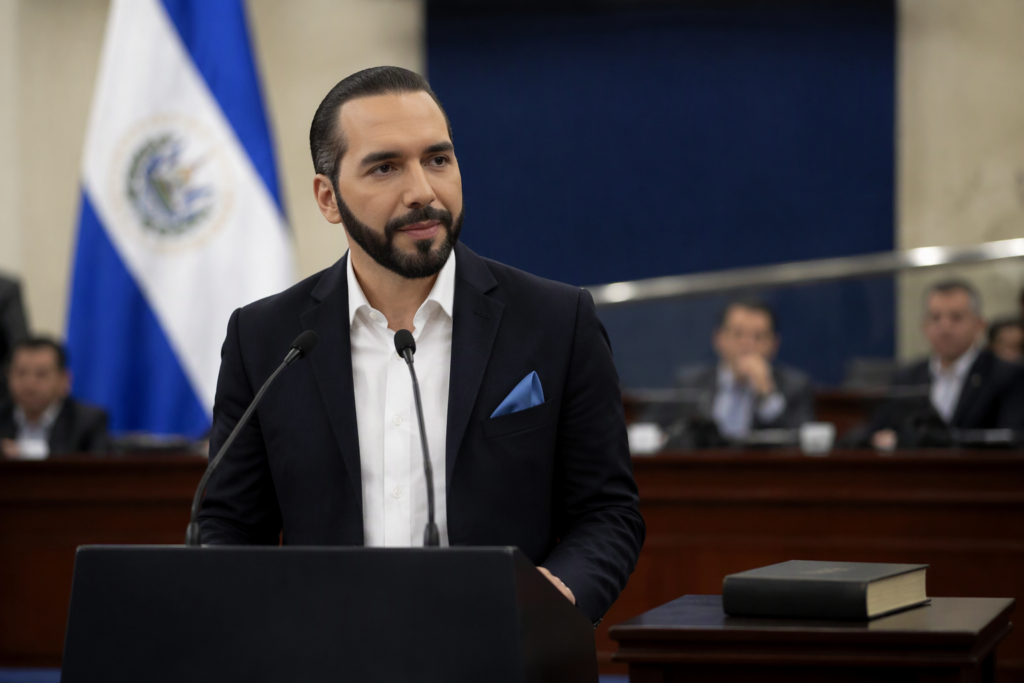
Crowds swarmed the Supreme Electoral Tribunal on Friday as President Nayib Bukele filed paperwork to run again, launching a controversial campaign for a Nayib Bukele third term that cements his grip on power.
The 45-year-old leader is already widely expected to win. His immense domestic popularity rests on a sweeping, hardline crackdown against El Salvador’s violent cartels, which drastically curtailed street crime across the country. Yet his latest bid follows an aggressive legal overhaul engineered by his loyal legislative majority, sparking fierce warnings from civil society and international monitors.
Also read: US Memo Warned Iran Blockade Was Driving Up Gulf Shipping Premiums
For Salvadorans, the move reshapes the democratic structure of the country for years ahead. The changes guarantee that Bukele can remain at the helm well into the 2030s without facing the constitutional hurdles that constrained previous leaders.
How the Nayib Bukele third term became legal
Bukele’s path to an extended presidency was cleared inside the national legislature. His ruling party, Nuevas Ideas, tapped its congressional supermajority to alter the El Salvador constitution, officially removing term limits on the presidency.
Lawmakers did not stop at erasing term caps. They also lengthened presidential terms from five years to six years, granting future winners longer continuous tenures. With the constitutional limits dismantled, the legal obstacles standing in front of a Nayib Bukele third term dissolved completely.
Standing before cheering supporters outside the tribunal, Bukele dismissed warnings about democratic backsliding. He insisted that the ballot box remains open to the public.
“In El Salvador there is total, complete open democracy,” Bukele told the crowd. “We’re sending a message to the world that El Salvador will never return to the past.”
Supermajority rewrites voting rules
The party’s control of Congress brought other sweeping changes to the country’s electoral mechanics. Lawmakers voted to eliminate second-round runoff elections entirely, lowering the threshold needed to claim executive victory.
Nuevas Ideas also brought forward the timetable for the national vote by two full years. Rather than waiting until the original schedule, the country will now hold national elections in February 2027.
These structural shifts ensure that opposition parties have less time to organize against an incumbent whose approval ratings remain sky-high. By shortening the campaign timeline and dropping the runoff requirement, Bukele’s party paved a direct, expedited route to the February 2027 elections.
Rights groups warn of one-party rule
Independent observers see these constitutional maneuvers as something far more dangerous than simple legal reform. Analysts and monitors, including the Bertelsmann Transformation Index, warn that Bukele is turning El Salvador into a de facto one-party state by systematically removing institutional checks and balances.
Watchdogs point out that Bukele’s allies previously packed the judiciary before dismantling election rules. Juan Pappier of Human Rights Watch criticized the reelection push, arguing that the administration has silenced dissent while rewriting the legal code.
Bukele is running for a third consecutive term after packing the court, rewriting the constitution to his liking and jailing or forcing into exile those who dare criticise him.
Pappier added that the absolute concentration of power in Bukele’s hands has become the defining feature of his administration.
Taking the security model abroad
Bukele’s domestic authority remains anchored in his persona as the leader who broke the country’s street gangs. Having quelled cartel power at home, he has started exporting his aggressive security model to foreign territory.
Last month, El Salvador deployed around 2,500 soldiers to Haiti. The deployment followed the disappearance of four Salvadoran members participating in a United Nations-backed force in the Caribbean nation.
Leaders in gang-ravaged Port-au-Prince welcomed the Salvadoran troops with open arms. Still, several political analysts questioned the real motive behind the mission, suggesting Bukele staged the overseas deployment primarily to burnish his international standing ahead of his campaign.
All eyes now turn to the Supreme Electoral Tribunal as it formally reviews and certifies Bukele’s candidacy for the upcoming ballot.
Source: Al Jazeera


