Standing before reporters in the White House briefing room, Donald Trump refused to say whether Russia’s president is a friend to the United States, even as he defended his own personal bond with the Kremlin leader. The exchange renewed intense focus on the Trump Putin relationship following an unprecedented summit in China.
Trump’s Friday remarks laid bare his worldview after meeting Vladimir Putin and Chinese President Xi Jinping earlier in the week. If you watched the briefing, the contrast was sharp: Trump touted warm ties with foreign autocrats abroad while threatening American tech leaders at home with punishing taxes if they shift sensitive hardware out of the country.
Also read: Four-Point Peace Declaration Issued by Trump, Xi and Putin
Top administration officials stood behind the lectern as Trump addressed foreign wars, party infighting, and nuclear strategy. The briefing showed a commander-in-chief determined to conduct foreign policy through personal chemistry, regardless of diplomatic tradition.
Inside the Trump Putin relationship after Beijing
When a reporter asked Trump about describing Putin as his “friend” during the Beijing talks, the president sidestepped whether Moscow treats America as an ally. “I can’t speak to America,” Trump said, before recounting how Putin had treated him during the investigation into his 2016 campaign. Trump claimed the Russian leader was “very nice” throughout what he labelled the “Russia hoax.”
Trump went on to frame the Trump Putin relationship as an asset tied directly to Moscow’s nuclear capabilities. “I consider him to be somebody that I have a very good relationship. And it’s actually very good,” Trump said, arguing that maintaining this rapport gives Washington an advantage. “I think it gives us a lot of additional strength,” he added.
Trump also praised what he called a “first of its kind trilateral peace agreement” with Putin and Xi. He described the gathering as one of the most momentous international summits in many years, pointing out that it marked the first-ever three-way meeting between the heads of state of the US, Russia, and China. Although the summit yielded no major formal pacts, Trump insisted the three leaders agreed to hold future discussions on nuclear proliferation.
A threat of heavy taxes over AI data centres
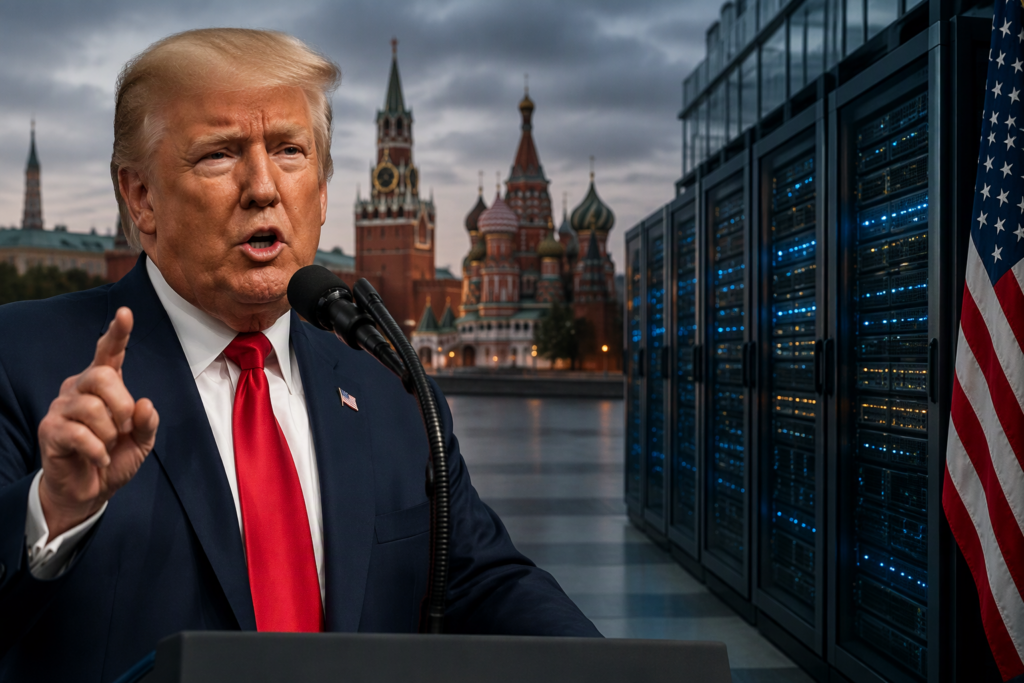
Turning from diplomacy to technology, Trump issued a blunt warning to American technology executives looking to expand computing infrastructure abroad. He stated that companies attempting to build new AI data centres overseas would face severe economic retaliation.
“We’re not allowing data centres to go into other countries because China will take all of them.”
He warned that any firm attempting such overseas moves would face a tremendous tax and steep financial penalties. Trump argued that allowing advanced computing capacity to leave American soil risks handing technological dominance straight to Beijing.
Yet Trump acknowledged that the policy remains an idea rather than an established regulation. He admitted he had not shared the proposal with his own administration officials before speaking at the lectern, and he offered no details on how the federal government would block private investments or enforce the penalties.
Tension over the Iran war and midterm fallout
The briefing also exposed lingering friction within the administration over foreign conflicts. With the Iran war approaching its 10-month mark, Trump accused Iranian leadership of dragging out negotiations and acting in bad faith. “They want to make a deal, but they don’t want to make a deal that’s acceptable to me,” Trump said, insisting on a genuine resolution. “We wanna make a real deal, not a fake deal.” He added: “They’ve been b*********** people for 51 years.”
Flanking the president were key cabinet members and advisers, including Treasury Secretary Scott Bessent, Defence Secretary Pete Hegseth, and newly appointed White House chief of staff Stephen Miller. Standing alongside them were Vice President JD Vance and Secretary of State Marco Rubio, both viewed as prospective contenders for the 2028 presidential race.
Trump addressed public friction with Vance, who recently linked historic Republican midterm losses to voter fatigue over the Iran war. Trump brushed aside suggestions of a rift, saying his staff are entitled to their views. “People that work for me, they have a right to their opinion,” Trump said, adding that had he faced the same choice again, “absolutely the answer is yes.” Vance stood by the commander-in-chief, telling reporters his sole job is to support the president’s decisions.
What to watch next as nuclear talks loom
All eyes now turn to whether Washington, Beijing, and Moscow will set dates for their promised nuclear proliferation negotiations, and whether the White House drafts formal rules on overseas data facilities.
Source: Al Jazeera