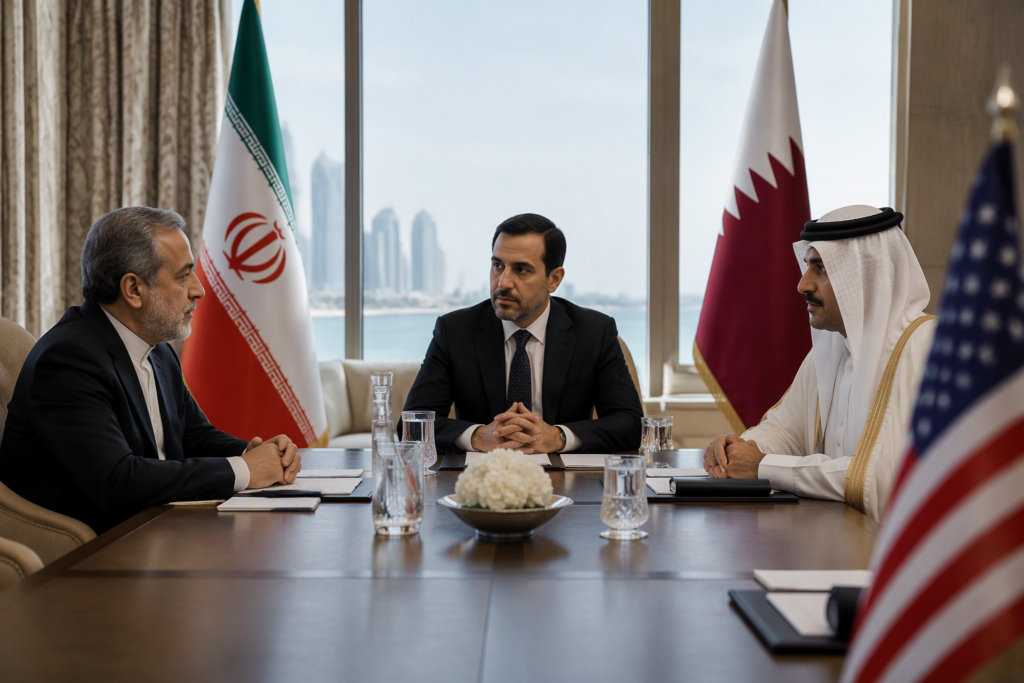
Qatari mediators spent two hours inside Tehran on Friday night trying to build a diplomatic bridge between Iran and the United States, even as Iranian warships kept the world’s most critical oil corridor choked off. Those quiet Strait of Hormuz talks mark the first public diplomatic opening since fighting erupted across the region earlier this year, but Iranian officials insist shipping lanes will stay closed until Washington dismantles its economic blockade.
The stakes stretch far beyond the Persian Gulf. Iran has halted commercial traffic through the waterway that typically handles about one-fifth of global petroleum supplies, sending fuel prices climbing worldwide and triggering a retaliatory American naval blockade against Iranian ports.
Also read: Strait of Hormuz Tankers Hit as Iran Restricts Shipping
Iranian Foreign Minister Abbas Araghchi made it clear on Saturday that talks alone will not clear the shipping lanes. Unless the White House accepts Tehran’s demands, he warned on state television, discussions over letting tankers pass are useless.
Inside the two-hour Tehran meeting
Qatari officials arrived in the Iranian capital late Friday for direct discussions with senior diplomats, according to Iranian Deputy Foreign Minister Kazem Gharibabadi. While the two-hour session did not turn into formal negotiations, it opened a channel to test whether Washington and Tehran can find common ground.
Gharibabadi told the semi-official Tasnim news agency that contacts with Qatari representatives are continuing in person and through virtual meetings. If both sides agree to formal bargaining, technical discussions over Iran’s nuclear work would sit on the table, though Tehran has drawn a firm boundary on its stockpile.
Gharibabadi insisted that enriched uranium will not leave Iranian soil under any scenario. He also warned that Iran views the American naval and economic restrictions as an act of war, pledging to take any action required to break Washington’s grip.
What Iran wants in Strait of Hormuz talks
Opening the vital shipping passage is straightforward if Washington shifts its stance, according to Araghchi. The foreign minister argued that the crisis can end quickly if American officials follow international law and reverse their current policy.
“Our position is clear: as long as Iran’s demands are not met, the discussion on the Strait of Hormuz and its opening is pointless.”
Tehran’s conditions for resolving the standoff require four major American concessions:
- An immediate halt to military conflict across all regional fronts.
- The unfreezing of billions of dollars in blocked Iranian assets abroad.
- The removal of sanctions targeting Iranian petroleum exports.
- An end to the US naval blockade currently surrounding Iranian commercial ports.
Araghchi stated there is no path forward unless the US acknowledges past errors and honours previous commitments, though he maintained that Iran remains ready to defend itself if diplomacy fails.
Trump pushes for a permanent nuclear freeze
Speaking on Fox News on Saturday, US President Donald Trump rejected Iranian terms and voiced deep frustration with Tehran’s leadership. Trump said his administration is holding out for a permanent agreement that completely strips Iran of any ability to build an atomic weapon.
Trump described Iranian negotiators as stubborn adversaries who routinely walk away from commitments. “We make a deal, and then they break the deal the next day,” Trump told the network.
The bitter rhetoric reflects the scale of the regional clash that began on February 28, when American and Israeli forces struck targets inside Iran. Tehran retaliated with waves of strikes hitting Israel and Gulf countries that host American military installations, dragging neighbouring states into the crossfire and disrupting global commerce.
Missile bunkers and a silent economic war
While diplomats traded messages through Doha, military commanders in Tehran sent a visible reminder of their firepower. Major-General Ahmad Vahidi, commander of the Islamic Revolutionary Guard Corps, toured an underground missile complex on Saturday alongside Brigadier General Majid Mousavi, head of the IRGC Aerospace Force.
Vahidi inspected launch units and received updates on Iran’s ballistic and cruise missile readiness. The tour followed the unveiling of a fortified subterranean base earlier this month, designed to keep missile stockpiles operational during sustained bombardment.
Above ground, Iranian President Masoud Pezeshkian acknowledged that ordinary citizens and industries are feeling the squeeze of isolation. Speaking to business leaders and investors, Pezeshkian described American sanctions as a silent economic war that cuts deeper than missile barrages.
Pezeshkian credited domestic manufacturers with keeping markets supplied despite foreign pressure, adding that state engineers are working urgently to prevent widespread winter power cuts. All eyes now turn to Doha and Tehran to see whether Qatari emissaries can coax both capitals into formal negotiations before winter energy shortages worsen.
Source: Al Jazeera


