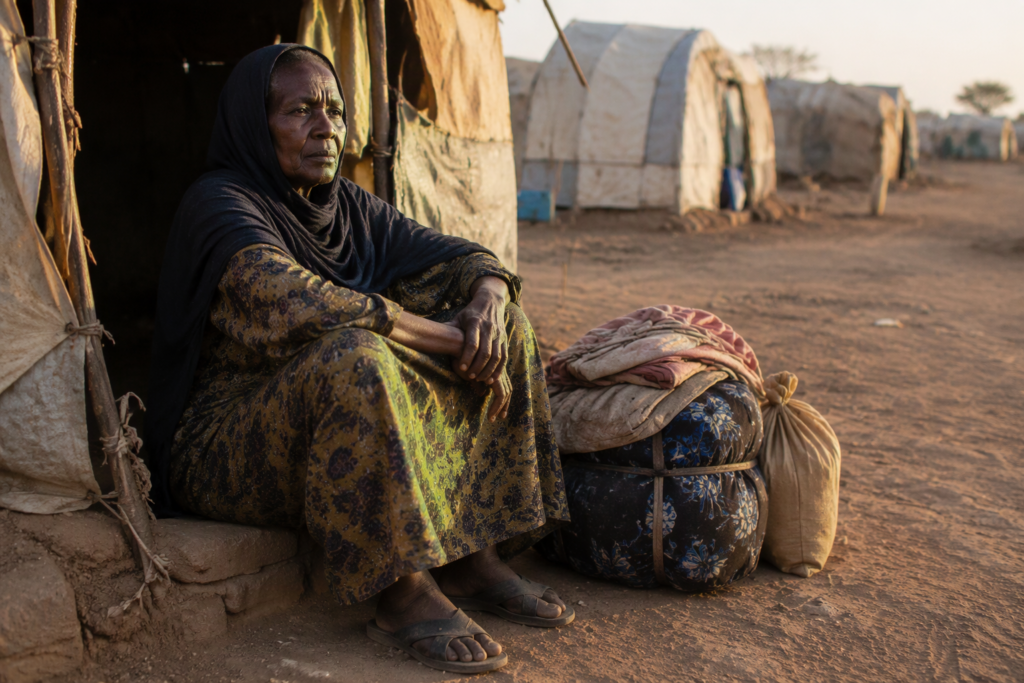
Hamad Mohammed Adam walked nearly 186 miles across desert scrub after gunmen stormed his village at dawn, but surviving the trek brought no relief. The 70-year-old farmer now sits inside al-Moulih camp in western Omdurman, cut off from medicine and unsure if his children are dead or alive. For thousands of Sudan displaced elderly, the country’s brutal war has torn away the family networks that kept seniors alive for generations.
When the fighting between the Sudanese Armed Forces and the paramilitary Rapid Support Forces exploded in April 2023, it uprooted millions. Yet older adults face a quiet emergency inside crowded settlement sites, where food lines move fast and chronic illnesses go untreated. In al-Moulih camp alone, about 2,000 of the 10,000 residents are over 65, creating an unprecedented wave of vulnerable seniors living on bare ground.
Also read: Israeli Attacks on Gaza Kill Four as Floods Swamp Camps
What happens to them matters because Sudan’s social foundation has cracked. In ordinary times, younger relatives manage doctor visits, gather food, and protect older kin. Today, family members are scattered across distant states or trapped across frontlines, leaving fragile parents to navigate survival alone.
Running 300 kilometres with nowhere to go
Adam’s ordeal began when fighters swept into his community near Bara, in northern Kordofan. He escaped with only the clothes on his back as gunshots echoed between houses.
“It was an early morning last August when the Rapid Support Forces militia invaded our village near Bara. It was a terrifying morning; they were killing everyone, women, men, children,” he said.
Adam ran alongside neighbours, spending days walking under scorching heat until he reached Omdurman displacement sites. Now, months later, he still has no way to trace his family. His daily focus narrows down to finding clean water and basic pain relief.
Aisha Alneel, 70, shares a similar heartbreak. She fled her home in Khartoum two years ago and now looks after her 72-year-old ailing sister in a displacement camp in Port Sudan. Both women had planned to move elsewhere, but drained savings trapped them in place. Alneel hopes only to find her relatives again and secure steady healthcare for her sister before their funds run out completely.
Why Sudan displaced elderly face unique dangers
Data from the UN Economic and Social Commission for Western Asia estimates that Sudan has 1.8 million people aged 65 and older, making up about 3.5 percent of the national population. These individuals depend heavily on routine medical supervision, blood pressure pills, and physical assistance with basic chores. When armed clashes force them from their neighbourhoods, those vital systems vanish instantly.
At the same time, the wider Sudan humanitarian crisis has stripped away economic lifelines. The United Nations Development Programme reports that Sudan’s economy has contracted by over 40 percent since the war started. Extreme poverty is projected to climb past 60 percent, dragging living conditions down to depths unseen since the early 1990s.
When families struggle to feed their own young children, caring for elderly relatives becomes nearly impossible. You can see the consequences across makeshift shelters, where aging men and women struggle with untreated diabetes, hypertension, and the deep emotional toll of displacement.
A care home fighting to keep its doors open
Formal institutions meant to shelter abandoned elders are buckling under the same pressures. In Khartoum state, staff at the Al-Daw Hajooj home for the elderly fight daily to protect just 11 senior residents.
Moubarak Satti, the director of the Al-Daw Hajooj home, explained that the facility operates without adequate funds to maintain regular eldercare programs. Conflict in the capital stripped the home of its most essential resources.
“We lost our only vehicle, which we use it to transport elderly people to medical facilities; we lost many people during the conflict due to the lack of medical care,” Satti said. He noted that handing out emergency grain bags is not enough; aid groups must build targeted health programs tailored directly to aging bodies.
Officials struggle against massive displacement
Government agencies acknowledge that the volume of suffering has outpaced their capacity. Around 8.6 million people are displaced across the country, making field outreach perilous and chaotic.
Khartoum State Minister of Social Welfare Siddig Ferini pointed out that persistent strikes on civilian districts cripple public utilities and block humanitarian relief. His ministry has managed to locate and reunite dozens of aging refugees with their sons and daughters across various states, but thousands more remain separated.
“We call on humanitarian organisations, donors, and philanthropists to support elderly people through social care and essential services, especially amid the ongoing war and economic crisis,” Ferini said. Local coordinators continue tracking scattered families as United Nations agencies prepare their next emergency relief appeals for central and eastern Sudan.
Source: Al Jazeera


