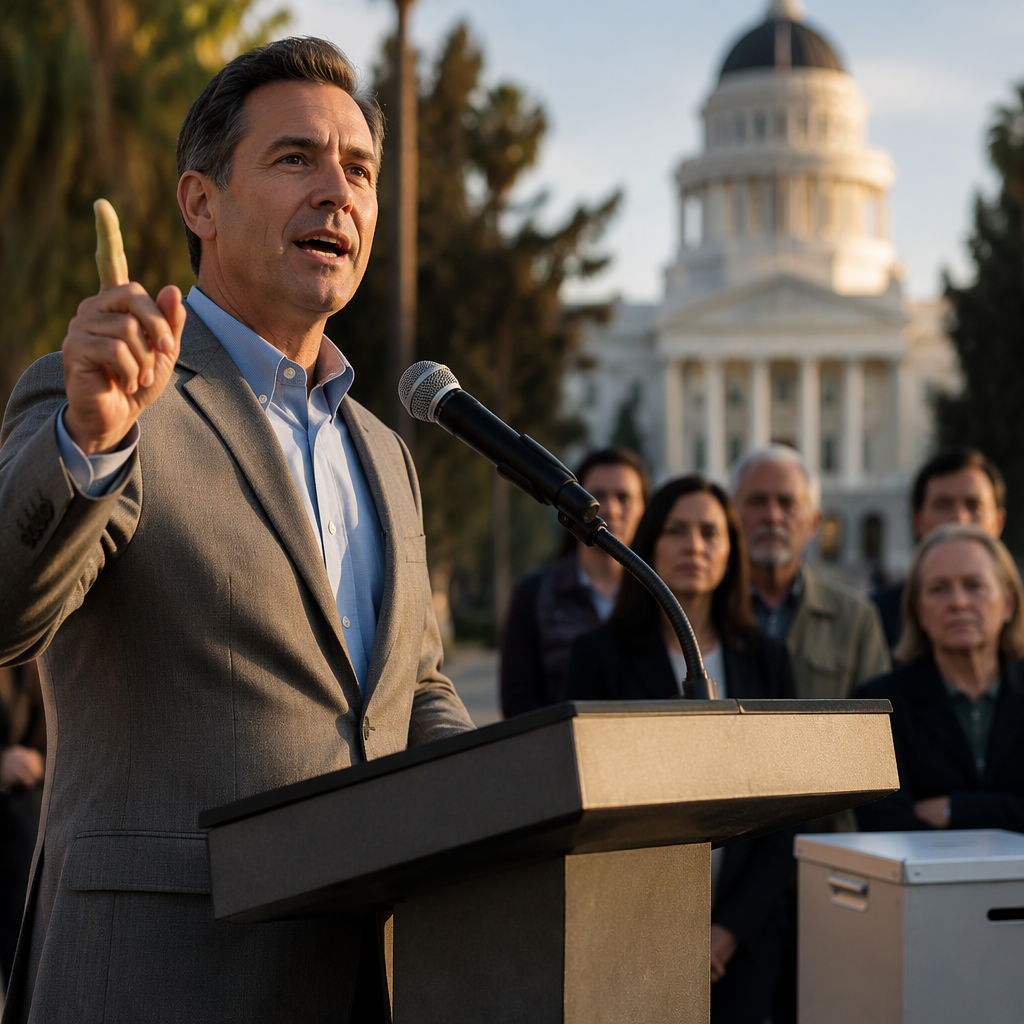

California Candidate Swipes at One-Party Rule in California Before Election
In a final appeal before voters cast their ballots, a prominent challenger took aim at what they termed “16 years of one-party rule in California,” framing the upcoming election as a critical referendum on state governance, affordability, and accountability.
The pointed critique comes during the closing stretch of the campaign cycle, as candidates make their final arguments to undecided voters. With key issues like housing costs, public safety, and energy policy dominating the public discourse, the challenger argued that prolonged legislative and executive control has created entrenched problems that require systemic political change.
Also read: Will Voters Approve a Landmark California Billionaire Tax?
Closing Arguments Focus on Cost of Living and Accountability
During campaign events held in the final sprint toward election day, the candidate urged voters to evaluate whether Sacramento’s political establishment has fulfilled its promises. Highlighting issues such as utility rate increases, persistent homelessness, and the rising cost of living, the campaign positioned itself as an overdue check on political power.
“When one group controls every lever of government without accountability, everyday families pay the price,” the candidate told supporters, emphasizing that healthy competition between political philosophies yields better public outcomes.
The push reflects a classic campaign strategy in the Golden State, where challengers frequently target the Democratic Party’s longstanding legislative supermajorities and control of statewide constitutional offices.
Challenging One-Party Rule in California
The phrase “16 years of one-party rule in California” refers to the sustained political dominance established following the end of Arnold Schwarzenegger’s governorship in early 2011. Since then, Democrats have consistently held the governor’s office and commanded decisive majorities in both the State Assembly and the State Senate.
Supporters of the current leadership argue that unified governance has allowed California to lead the nation in environmental standards, healthcare access, and technological innovation. Incumbents and allied leaders defend their tenure, pointing to substantial investments in public infrastructure, green energy initiatives, and historic budget protections.
However, critics contend that the lack of robust political opposition has insulated policymakers from necessary scrutiny. Independent oversight groups have often noted that one-party dominance can streamline legislation, but it can also marginalize minority viewpoints and slow bipartisan problem-solving.
The Battle for Independent and Moderate Voters
The strategy to focus on governance rather than strict partisan ideology is designed to appeal directly to California’s large bloc of registered “No Party Preference” (independent) voters. In competitive legislative districts and statewide contests, swaying these unaffiliated voters is vital for any challenger hoping to overcome the state’s partisan registration deficit.
Political analysts observe that focusing on pragmatic daily concerns—such as grocery prices, property insurance availability, and school performance—resonates more broadly with independent voters than ideological rhetoric.
Recent polling suggests that while voters remain loyal to core social values, economic anxieties and frustration over state management run high across all demographics.
What Happens Next
With voting centers open and mail-in ballots arriving across the state, election officials remind voters that all ballots postmarked by election day will be counted. Campaign teams are now deploying field operations to ensure maximum voter turnout in tight districts.
Whether this late-stage swipe against one-party rule in California will alter the political landscape remains in the hands of the electorate. The election results will signal whether voters are ready to demand a new balance of power or reaffirm their confidence in the current direction of state leadership.