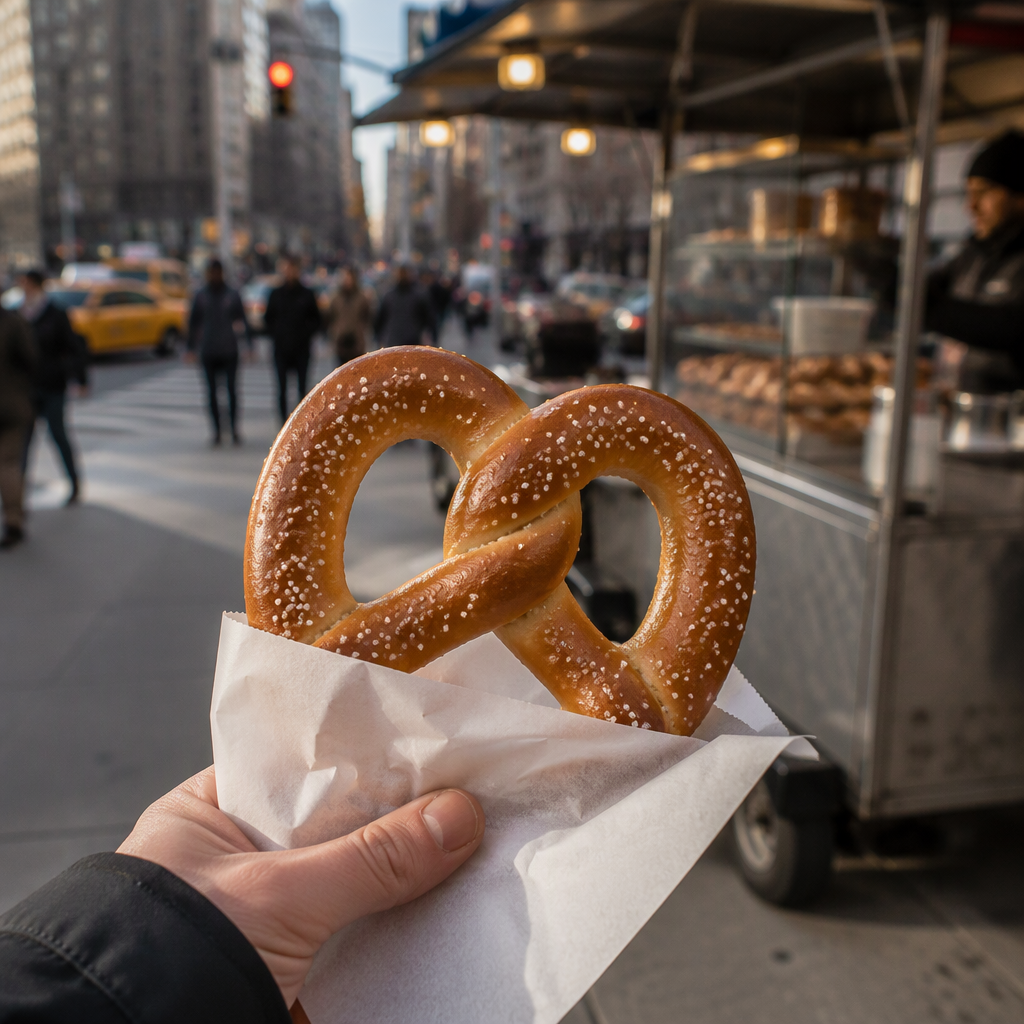

The Hunt for New York’s Most Authentic Pretzel: Bakers Revive a Street Icon
For more than a century, few culinary symbols have captured the rhythm of Manhattan sidewalks quite like the warm, salted twist pulled from a vendor’s cart. Yet for modern food historians and discerning eaters, the quest for an authentic New York pretzel has increasingly shifted away from street corners and toward independent bakeries determined to rescue an imperiled tradition.
Today, the street carts clustered around Midtown and Central Park often sell mass-produced, frozen dough warmed in humid display cases. In response, a growing movement of culinary artisans, heritage German beer halls, and independent bakers across New York City is working to restore the craftsmanship that first made the twisted snack famous.
Also read: How the Tuscan Nonna Teaching the Internet to Cook Is Reviving Traditional Italian Food
The Immigrant Roots of a Sidewalk Staple
The pretzel arrived in New York during the 19th century alongside waves of German immigrants who settled in neighborhoods such as the Lower East Side and Yorkville. Known historically as Kleindeutschland, or “Little Germany,” downtown Manhattan was once home to dozens of neighborhood bakeries producing fresh Laugengebäck—traditional lye-dipped baked goods.
By the early 20th century, street peddlers carried fresh pretzels on long wooden dowels, selling them to dockworkers, factory laborers, and commuters for pennies. The snack’s portability and affordability established it as an essential piece of working-class New York food culture, alongside the bagel and the hot dog.
However, industrial consolidation in the late 20th century altered the landscape. Rising production costs and regulatory shifts led cart vendors to rely on commercial suppliers delivering frozen, machine-twisted dough. Over time, the chewy, glossy crust and nuanced malt flavor of the original pastry were replaced by dense, spongy starches that required liberal coats of yellow mustard to stay palatable.
Defining the Authentic New York Pretzel: Lye, Salt, and Technique
Culinary experts point out that creating an authentic New York pretzel requires strict adherence to chemistry and patience. Unlike typical bread baking, traditional Bavarian and German-American pretzels depend on specific techniques that cannot be replicated through shortcut industrial freezing.
The Food-Grade Lye Bath
Authenticity begins with a dip in a sodium hydroxide (food-grade lye) solution before baking. The high alkalinity triggers an intense Maillard reaction in the oven, yielding a deep mahogany color, a paper-thin exterior shell, and the distinct mineral snap that baking soda substitutes fail to achieve.
Slow Fermentation and Malt
Historic recipes rely on non-diastatic barley malt syrup and long, cold fermentation cycles. This slow proofing process develops complex yeast notes, balancing the interior’s pillowy crumb against the alkaline crust.
Coarse Salt Crystals
Authentic pretzels require non-iodized pretzel salt—flat, rectangular crystals that adhere without melting into moisture droplets or overpowering the dough with pure salinity.
Where the Hunt Leads: New York’s Modern Artisanal Strongholds
Food lovers tracking the city’s finest pretzels are finding them inside community craft bakeries and historic cultural enclaves rather than tourist-heavy intersections.
In Brooklyn, operations such as Bien Cuit and specialty purveyors across Gowanus and Greenpoint have experimented with heritage flours and traditional lye dips, presenting small-batch batches that sell out within hours. In Queens, established German heritage centers like Zum Stammtisch in Glendale maintain century-old standards, serving oversized, deeply browned twists directly alongside house-made mustard.
Meanwhile, Manhattan operations like Sigmund’s Pretzels, which helped pioneer the modern pretzel renaissance in the East Village, proved that New Yorkers were willing to pay for hand-rolled, properly proofed dough. These bakeries treat the pretzel with the same technical rigor typically reserved for sourdough baguettes and traditional bagels.
Challenges Facing Small-Scale Pretzel Bakers
Despite consumer enthusiasm, scaling authentic production remains difficult in New York’s competitive food sector. Working with food-grade lye requires strict safety protocols, specialized ventilation, and dedicated prep spaces that small commercial kitchens often struggle to accommodate.
Additionally, hand-twisting dough is labor-intensive. While a machine can produce hundreds of uniform shapes per minute, an experienced baker produces fewer than ten an hour by hand, driving retail prices to five dollars or more per pretzel—a stark contrast to two-dollar street cart offerings.
What Happens Next
As consumer demand for heritage baking continues to surge, industry observers expect more micro-bakeries and craft breweries to partner on fresh daily deliveries. Collaborative pop-ups and farmers market stalls are increasingly serving as testing grounds for next-generation bakers eager to honor New York’s street-food heritage.
The ongoing search confirms that the authentic New York pretzel is far from obsolete. While the days of finding artisan-grade pastry on every street corner may be gone, the city’s craft bakers are ensuring that the genuine article remains a vibrant part of New York’s living culinary history.