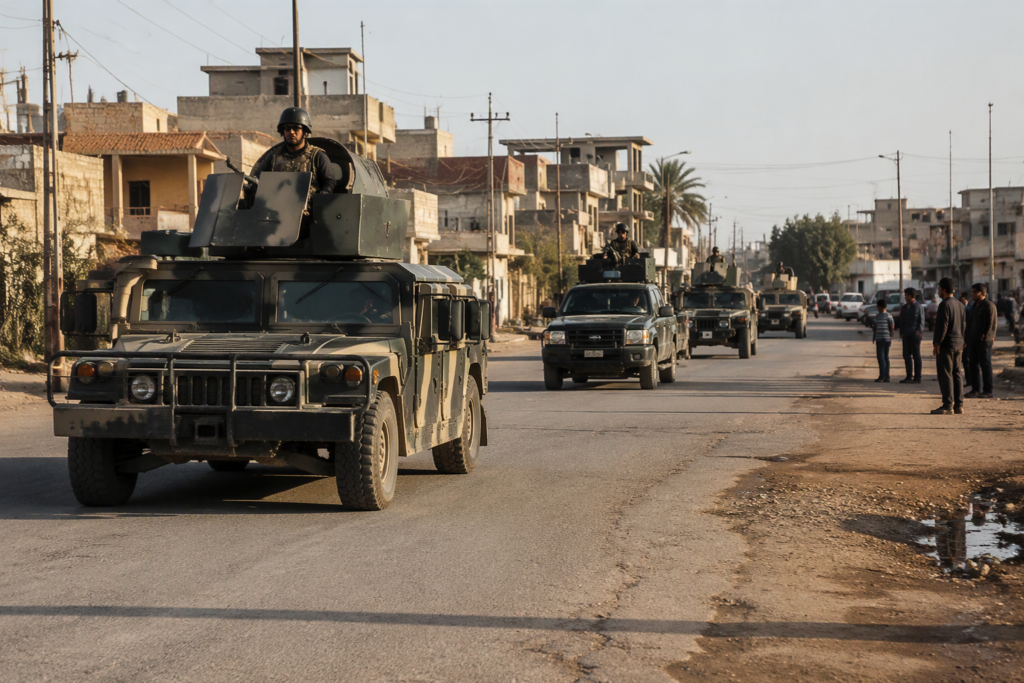
Iraqi soldiers are moving toward the fortified town of Jurf al-Nasr with orders to force out Kataib Hezbollah fighters by Friday, risking an armed showdown just south of Baghdad. The confrontation follows an explosive government inquiry into illicit oil refineries that have drained state coffers for years.
Prime Minister Ali al-Zaidi directed regular military units to surround the enclave and prepare to enter, according to government spokesman Haidar al-Aboudi. Iraqi security agencies have already shut down transit corridors around the town, barring all fuel tankers and petroleum trucks from leaving.
Also read: Oil Smuggling Crackdown Targets Iraqi Militia Stronghold
The move pushes Baghdad into its most direct domestic security crisis in months. Jurf al-Nasr, previously known as Jurf al-Sakhar, has operated for years as a closed garrison town for Kataib Hezbollah, shielded from state oversight while functioning as a base of political and military leverage.
The Friday deadline in Jurf al-Nasr
Government officials made clear that the standoff will not drag on indefinitely. Al-Aboudi told local media that the timeline given to the group is short, and a senior Iraqi official confirmed the fighters must withdraw completely before the end of the week.
The central government has deployed reinforcement units along the perimeter of the town to secure surrounding roads and checkpoints. That military presence is intended to enforce the eviction order and stop any armed resistance before troops move into the interior districts.
For residents and security forces across central Iraq, the friction carries immediate danger. Kataib Hezbollah is among the most heavily equipped paramilitary factions in the country, maintaining semi-official status while resisting operational command from the prime minister’s office.
Black-market crude and buried pipelines
The immediate trigger for the military push is a sweeping anticorruption inquiry aimed at dismantling an underground petroleum network. Investigators say illicit refineries inside Jurf al-Nasr have siphoned government oil for years, costing Iraq hundreds of millions of dollars since 2021.
Al-Aboudi revealed that a state investigative team, acting on intelligence agency dossiers, discovered physical tampering on major pipelines running through the area. Workers had deliberately buried pipes and hidden valves under soil to conceal illegal tap points feeding clandestine refining operations.
The inquiry has already shaken the state bureaucracy, leading to the dismissal of senior government officials and regional security directors. Authorities have referred nine high-ranking officials to the judiciary on corruption charges linked to facilitating the black-market fuel trade alongside militia commanders.
Kataib Hezbollah rejects smuggling claims
Leaders of the armed faction have pushed back aggressively against the allegations, insisting their facilities hold no illegal tap lines. In a public statement released on Sunday, the group accused the prime minister of manufacturing the oil dispute to strip them of their arsenal under foreign direction.
“We are therefore being subjected to the greatest campaign of blackmail aimed at forcing us to relinquish the weapons of dignity that have upheld sovereignty and protected the rights of Iraqis at multiple stages,” the group said in a statement.
Kataib Hezbollah and allied factions have consistently defied disarmament demands issued by al-Zaidi and US President Donald Trump. Independent security analysts view the fuel investigation as a deliberate push by Baghdad to cut off the self-funded revenue streams that allow such militias to operate outside state control.
Regional pressure on Baghdad
The showdown in Jurf al-Nasr unfolds against the backdrop of broad geopolitical conflict across the Middle East. Washington and allied Gulf capitals have increased pressure on al-Zaidi to rein in Tehran-aligned groups stationed inside Iraq.
Those tensions escalated sharply after the United States and Israel launched a war against Iran in February. In response, Kataib Hezbollah launched strikes against American military garrisons as well as commercial and infrastructure sites in Saudi Arabia and the United Arab Emirates.
How the faction responds as the Friday deadline expires will determine whether Baghdad can enforce its authority over its own territory without igniting open combat on the roads leading into the capital.
Source: Al Jazeera


