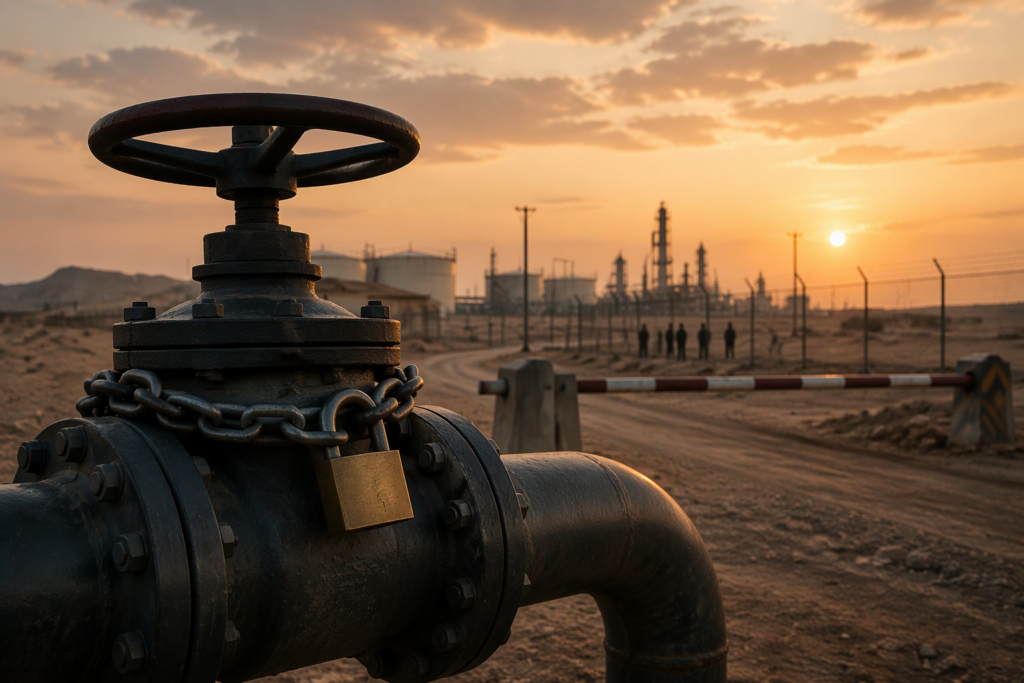
Iraqi security forces just walked into a forbidden garrison town that no prime minister had dared enter for a decade. The sudden move marks the start of a high-stakes oil smuggling crackdown aimed at cutting off illicit cash flow to powerful, Iran-backed armed groups without firing a shot.
For years, militias operated with impunity across Jurf al-Sakhar, running underground oil networks and storing heavy weapons just 60 kilometers south of Baghdad. Now, Prime Minister Ali al-Zaidi is betting that seizing illicit crude profits will force these factions to fall in line after they ignored official disarmament deadlines earlier this year.
Also read: Iraq Oil Smuggling Crackdown: PM Sacks Nine Top Officials
If the plan succeeds, it will shift power back to the state in one of Iraq’s most dangerous territory disputes. If it falters, Baghdad risks a direct confrontation with entrenched paramilitary factions that have spent ten years building a fortress on the capital’s doorstep.
Inside Jurf al-Sakhar’s illicit refineries
Jurf al-Sakhar, renamed Jurf al-Nasr by paramilitary groups, has been off-limits to federal authorities since 2014. Militias took the town during the fight against ISIL and cleared out its Sunni population. Kataib Hezbollah, an armed group with close ties to Tehran, turned the area into an armed redoubt.
The town sits at an intersection near the Shia pilgrimage route between Baghdad and Karbala. During Saddam Hussein’s rule, the area housed massive military industrial complexes. Those old facilities gave militias an ideal hiding spot to assemble, test, and conceal rockets, drones, and ballistic missiles.
Behind the blast walls, a lucrative shadow economy took root. An Iraqi intelligence report released last week revealed that Jurf al-Nasr was operating as the hub of a vast corruption racket fed by illicit oil refineries and diversion pipelines.
A federal security committee entered the town on Friday to inspect the sites. The move was unprecedented for an area that had become an autonomous militia enclave.
Sacking bosses and severing militia funds
Prime Minister al-Zaidi launched the offensive by targeting the civilian and security officials who shielded the illicit trade. The government dismissed nine senior officials and referred them to the judiciary on corruption charges.
The sackings reached the top of regional law enforcement and energy management. The government dismissed the Babil police chief, several top security directors, and the head of the Oil Pipelines Company inside the Ministry of Oil. The dismissals sent a clear signal through the civil service that state cover for illicit fuel trading has run out.
Security analyst Saif Raad pointed out that the intervention broke a decade-long barrier.
“Jurf al-Sakhar has been around for, let’s say, more than ten years; for ten years no prime minister was able to enter this area.”
Raad explained that the operation tells Iraqis that no armed faction sits above the law. By stripping away administrative protection, Baghdad hopes to drain militia coffers before the groups can react.
The financial damage to Kataib Hezbollah may be limited at first. Michael Knights, head of MENA research at Horizon Engage, noted that the group relies on diversified revenue streams across Iraq. But cutting off local pipeline taps takes away an easy, dependable source of untraced income.
Why this oil smuggling crackdown avoids bloodshed
Taking on heavily armed factions usually sparks street fighting. Yet Baghdad managed to enter the zone without a single recorded casualty. The strategy relied on quiet political maneuvering before any police convoys hit the highway.
Prime Minister al-Zaidi worked with allied leaders inside the Popular Mobilisation Forces before making his move. He sought backing from the Badr Organisation, the largest armed component in the network, led by Hadi al-Amiri.
Iraqi political analyst Fadel Abu Ragheef observed that coordinating with al-Amiri was vital to keep the PMF aligned with the state. By winning over the biggest faction, the prime minister isolated Kataib Hezbollah and avoided armed resistance.
A wider internal conflict between Shia groups remains unlikely. Political analyst Ali Fadhlallah explained that the authority of Grand Ayatollah Ali al-Sistani continues to steady the political system during tense standoffs. Sistani’s guidance serves as an unwritten limit that prevents rival factions from turning their guns on each other.
What the government must prove next
The state has taken its first steps, but holding Jurf al-Sakhar requires much more than paperwork and inspections. You cannot claim full control of a town until its rightful residents can walk down the street without fear.
Sunni families expelled from the area in 2014 are still waiting to go home. Knights compared taking complete control of the area to driving Hezbollah out of Lebanon’s Bekaa Valley. He warned that establishing total state authority remains a difficult goal.
For now, al-Zaidi has proven that the state can dismantle fuel taps without igniting a street war. Watch the Babil courts in the coming weeks as prosecutors present evidence against the nine sacked officials to see if these high-level corruption charges actually stick.
Source: Al Jazeera


