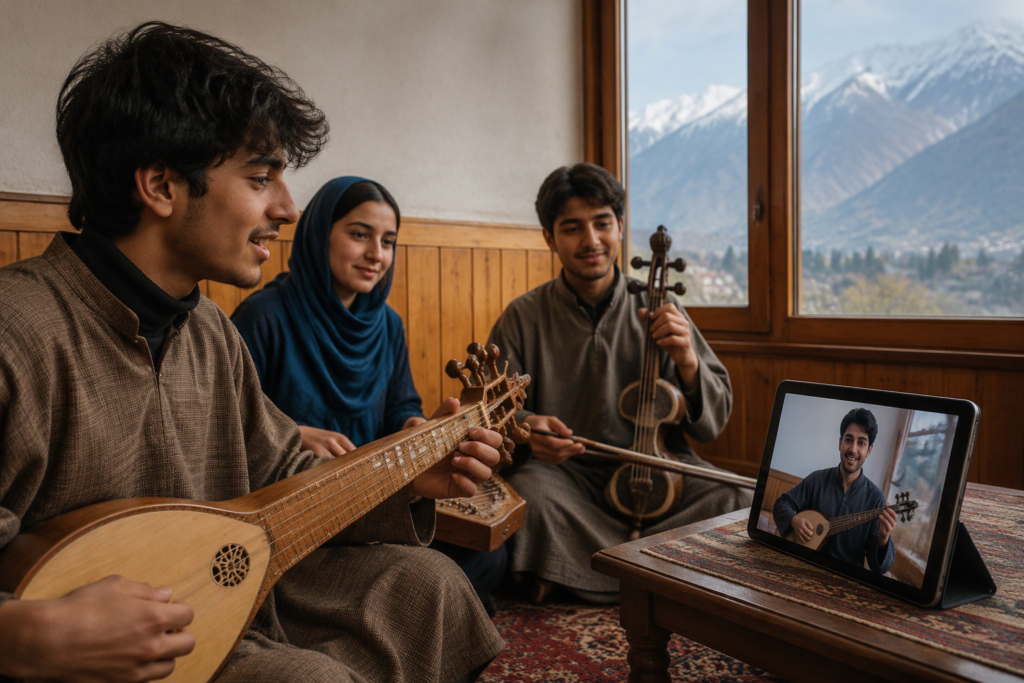
Aasim Yaseen was walking through his mountain village of Buglinder when a college student stopped him in the street, pulled out a phone, and played back Yaseen’s own voice singing in Shina. For the 25-year-old singer from the remote Tulail Valley, that brief encounter was proof that Shina music is doing what political treaties and closed borders cannot: bridging a divided homeland along the heavily fortified Line of Control.
For decades, barbed wire, mountain bunkers, and military checkpoints have split the Indigenous Dard community across Indian-administered Jammu and Kashmir, Indian-administered Ladakh, and Pakistan-administered Gilgit-Baltistan. Direct phone calls and text messages across the border carry security risks and invite official scrutiny. Instead, young artists are posting folk melodies and pop rhythms on YouTube and Facebook, letting their shared mother tongue travel safely over the ceasefire line.
Also read: Valley of Cuelgamuros: Families Fight to Reclaim Dead
What changes through these digital uploads is the survival of an isolated linguistic culture. By tuning into the same songs without exchanging private messages, families long cut off from their ancestral branches can reaffirm their kinship and keep their endangered language alive.
How Shina music travels where phone calls cannot
In places like Gurez and Drass on the Indian-administered side, residents hesitate to dial numbers or send messages across the frontier. Local border crossings between Gurez and Gilgit-Baltistan never existed, unlike bus corridors that once linked Srinagar with Muzaffarabad before those routes also closed. Listening to a public song online offers a safe alternative.
“Through music, we could convey a message without having to send it,” explained a 35-year-old schoolteacher from Purana Tulail village, who asked to withhold his name over safety worries. “When a singer from this side sings, our community across the border listens to it.”
The practice began gathering steam in the late 2010s before expanding widely around 2020. Today, tracks recorded in makeshift spaces ripple through mountain valleys on both sides of the Kishanganga River, which flows past military surveillance cameras into Pakistan-administered territory.
Missing maps and unexpected family discoveries
Across the dividing line in Gilgit, 38-year-old folk singer Salman Paras has experienced the power of this musical lifeline firsthand. Born in Sheikhpora Kilshay in Astore district, Paras grew up listening to elders speak of relatives left behind on the Indian side during Partition.
After Paras uploaded traditional songs online, a musician across the border contacted him. Listeners had traced branches of his family to Kangan, a town in central Kashmir where many families from Tulail resettled after regional conflicts. While the families have not yet reconnected in person due to security barriers, the song acted as an ancestral registry.
“If you look at the official map of Gilgit-Baltistan today, Gurez and Ladakh are missing. But in my mind, I’ve drawn a cultural map that includes Chitral, Kohistan, Gurez and Ladakh. They are my people.”
Paras later collaborated with Pakistani pop star Ali Zafar on the hit track Karay Karay, filmed in Skardu’s cherry blossom groves and the Katpana Desert. The video introduced Shina language music to millions of international viewers and led to stage performances in Dubai and Muscat.
Sharing microphones and splitting studio bills
The cultural revival comes at a heavy personal cost for the young performers. In villages near the boundary, mobile networks flicker out, and winters trap communities under heavy snow for months at a time.
Yaseen studies music at Cluster University in Srinagar, roughly 160 kilometres from home, and returns to help his 71-year-old father, Abdul Rahim Sheikh, tend cattle and fence potato fields. Booking a professional studio in Srinagar costs between 30,000 and 35,000 Indian rupees ($318 to $372) per song—a steep sum for an independent artist. To survive, musicians pool their money, sharing microphones, speakers, and editing software. For his April release Malalak, Yaseen split production costs with fellow musician Zia Ul Alam.
Other regional performers face identical bottlenecks:
- Younis Majeed, 27, of Izmarg village, mixes traditional tunes with modern beats, drawing over 21,000 plays for his track Tamah Hoon.
- Iftikhar Uddin Iftikhar, 29, records in Gilgit studios after learning from folk master Muhammad Amin Shah.
- Zain Drassi, 24, performs at festivals in Ladakh, but must travel hundreds of miles to Himachal Pradesh or Srinagar to find arrangers and traditional acoustic instruments.
Carrying the songs from Kargil to Kangan
The modern digital movement builds on decades of quiet preservation by older generations who had no internet. In Kangan, 53-year-old singer Yousuf Naseem still plucks a six-stringed rabab on his veranda, singing ballads passed down before his family was uprooted from Gurez during the 1999 Kargil War.
Years ago, Naseem carried his first cassette, Dardistan, into Srinagar’s historic Bohri Kadal market. He asked a local shopkeeper to play it every morning just so passing city residents would ask what language was echoing through the street.
Today, that acoustic memory has turned into an active cross-border network. During a recent Instagram live stream that drew listeners from Gurez, Drass, Kargil, and Gilgit, Paras announced he is seeking travel permissions and visas to perform live in Gurez and Ladakh, setting up what could be the first in-person concert tour uniting Shina speakers across the Line of Control.
Source: Al Jazeera


