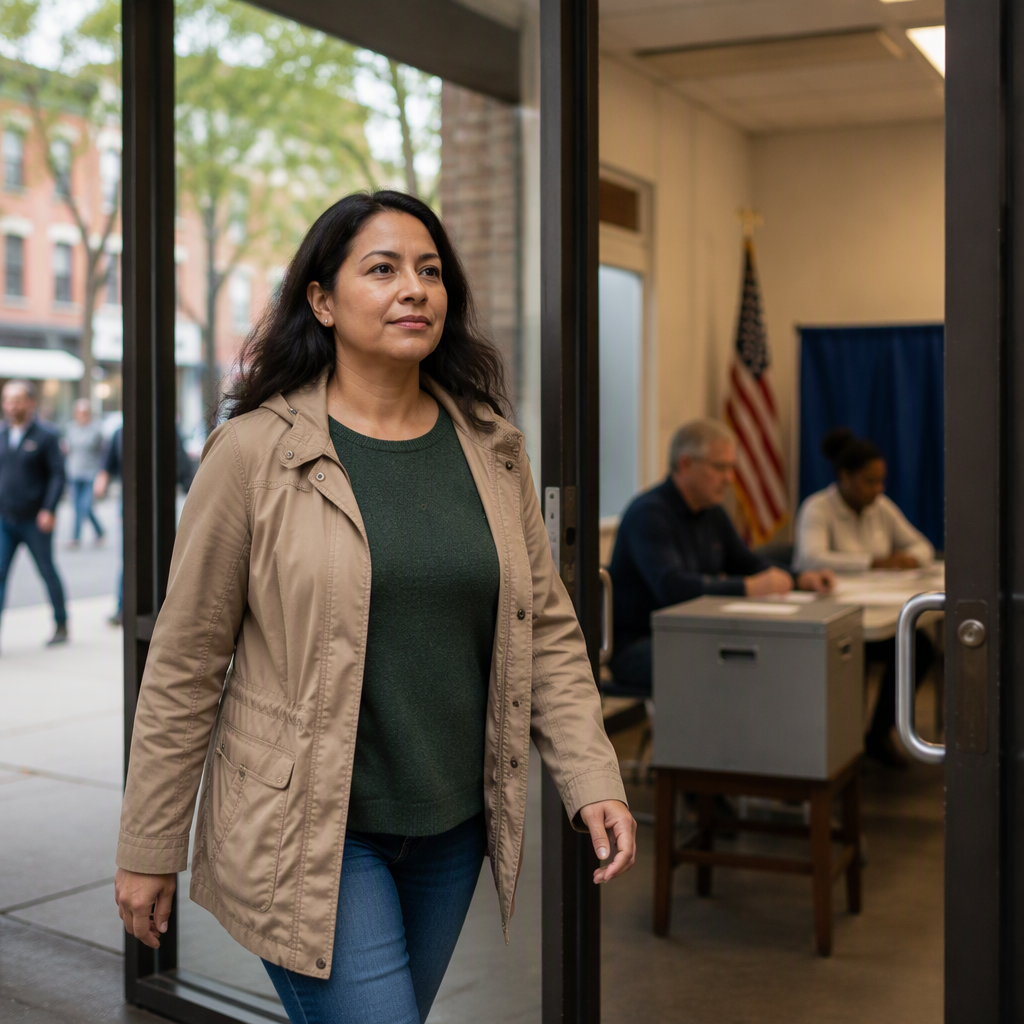

Mamdani’s Midterm Message to Voters Stirs Debate on ID Laws and ICE
New York State Assemblymember Zohran Mamdani’s midterm message to voters advising constituents on state voting procedures and interactions with federal immigration authorities has sparked widespread discussion across New York’s political landscape. The guidance, aimed at clarifying election laws and reducing intimidation at polling sites, highlighted key provisions of New York State election statutes and federal enforcement policies.
In communications directed to his Astoria, Queens district and shared across social platforms, the Democratic socialist lawmaker reminded New Yorkers that registered voters are generally not required to show photo identification to cast a ballot in the state. Mamdani also emphasized that Immigration and Customs Enforcement (ICE) agents are barred from conducting operations inside polling locations under established federal protected area guidelines.
Also read: Zohran Mamdani ICE Video Sparks Backlash Over Guidance on Immigration Enforcement
Clarifying New York State Voter Identification Rules
A central pillar of Mamdani’s voter education effort focused on New York’s specific voting procedures. Under New York election law, most registered voters verify their identity at polling sites through signature comparison rather than by presenting government-issued photo identification.
When a voter arrives at their assigned polling place, poll workers compare the signature provided on the poll pad or ledger with the signature on file from the individual’s voter registration form. Photo identification is only required in limited circumstances, such as for certain first-time voters who registered by mail without providing a driver’s license number, state ID number, or the last four digits of their Social Security number.
Advocates note that misconceptions about voter ID rules often lead registered citizens to believe they cannot vote if they do not possess a valid state ID or driver’s license. Mamdani’s message sought to dispel these misunderstandings to ensure registered voters are not turned away unnecessarily.
Federal Guidelines and ICE Presence at Polling Places
The guidance also addressed concerns regarding immigration enforcement near voting precincts. Under federal policy established by the Department of Homeland Security (DHS), polling stations are designated as protected or “sensitive” locations. DHS guidelines generally prohibit ICE and Customs and Border Protection (CBP) officers from conducting surveillance, arrests, or enforcement operations at or near voting sites.
Federal law additionally provides strict safeguards against voter intimidation. Under Title 18, Section 594 of the United States Code, any attempt to intimidate, threaten, or coerce any other person for the purpose of interfering with the right of such other person to vote is a federal offense.
Mamdani encouraged voters and poll workers to know their rights, asserting that federal agents have no legal authority to interfere with voting operations or demand documentation from individuals exercising their civic franchise.
Reactions to Mamdani’s Midterm Message to Voters
The public response to Mamdani’s voter instructions highlighted contrasting perspectives on election administration. Supporters praised the outreach as a crucial defense of civil rights in diverse, immigrant-dense communities where misinformation or fears of federal enforcement can depress voter turnout.
“Educating our community about their actual legal rights at the ballot box is essential,” voting rights advocates stated during discussions around the campaign. “Fear and confusion remain among the biggest barriers to civic engagement.”
Conversely, political critics and conservative commentators pushed back against the rhetoric. Opponents argued that advising voters against bringing identification could undermine public confidence in the security of the ballot. Some critics also characterized the emphasis on denying entry to ICE agents as politically charged messaging aimed at stoking partisan tensions rather than simply providing basic civic information.
What Happens Next
As election cycles approach, voter access and ballot security remain prominent topics of debate in the New York State Legislature. Lawmakers continue to deliberate on measures regarding automatic voter registration, no-excuse absentee voting, and local election governance.
Election officials in New York City have reaffirmed that trained poll workers and coordinators are instructed to maintain secure, compliant, and accessible voting environments for all registered voters. As discussions over voting rights continue to shape state and national politics, the principles highlighted in Mamdani’s midterm message to voters remain at the center of ongoing legal and policy debates.

2 Comments
Comments are closed.