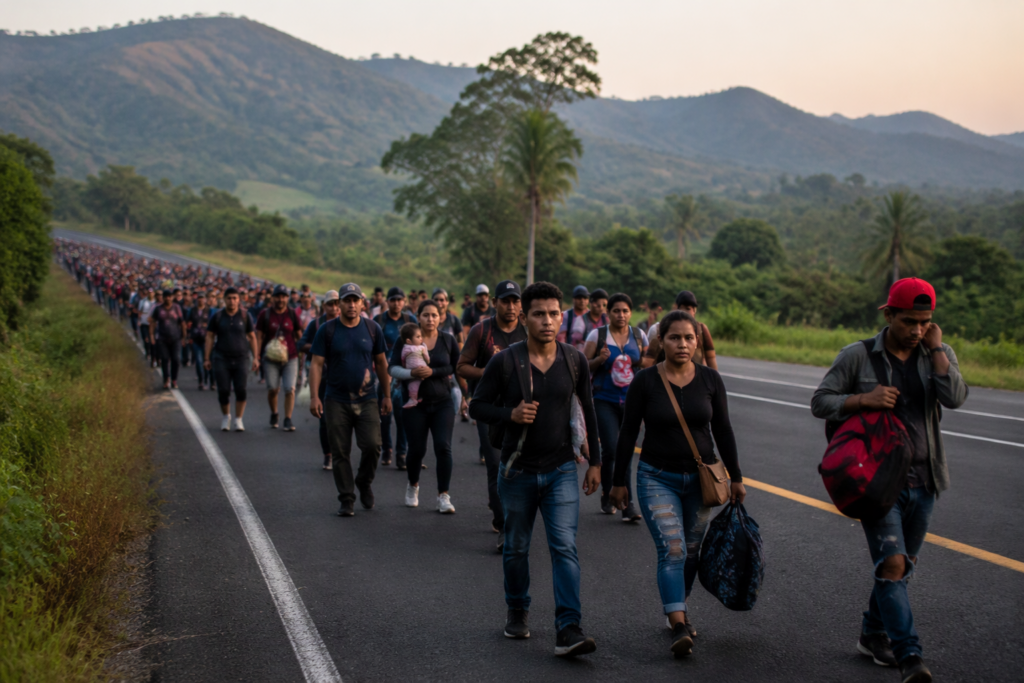

Facing economic threats from Washington, about 1,500 people formed a new migrant caravan in southern Mexico this week, betting that a shift in American politics might finally give them a chance at crossing the border.
The group departed Tuesday from Tapachula, a border hub near Guatemala, pushing north along highways in Chiapas. Parents pushed strollers or carried toddlers on their shoulders in the tropical heat. Their immediate goal is Mexico City, more than 600 miles away, where they hope to secure federal protection against deportation and avoid local sweeps.
Also read: David Walliams Books to Stay on Shelves at Guernsey Library
The mass movement quickly drew a fierce response from United States President Donald Trump, who threatened Mexico with steep economic retaliation on Thursday if its security forces fail to halt the march.
Trump threatens double tariffs as march begins
Writing on Truth Social, Trump demanded that Mexican authorities intercept the travellers before they advance further toward the US boundary. He warned that failure to do so would result in the United States doubling its existing trade tariffs against Mexico.
Trump claimed that a “perceived loss” by Republicans in last week’s midterm elections had emboldened people to organise the march. In those congressional elections, Democrats took back control of both the House of Representatives and the Senate after flipping seats across the country.
Trump also stated that he was placing the incoming Democratic governor of Texas on notice over border enforcement. That seat was recently won by Gina Hinojosa, who became the first Latina elected to govern the border state.
Why the migrant caravan chose this moment
The group, calling itself “God With Us”, consists primarily of people from Central America who had spent months trapped in Tapachula. Under tightened border policies and ongoing deportations, thousands of people have accumulated in the southern city, where jobs remain scarce and families struggle to access healthcare and schools.
While caravans frequently organise in Chiapas, participants acknowledged that the election results in Washington gave them renewed momentum. Many saw the midterms as a public rejection of Trump’s enforcement measures.
Cesar Sandoval, a 47-year-old Nicaraguan who was deported from the US earlier this year, explained why he decided to join the trek north.
“There might be a light at the end of the tunnel, a way for us to get in. We believe the Democrats will help us.”
Crackdowns along the Suchiate River
Even as the main group moved forward, Mexican forces acted quickly to break up other crossings nearby. Along the Suchiate River, which marks the border between Mexico and Guatemala, Mexican National Guard troops, police and immigration agents intercepted a separate group of about 100 people on Tuesday.
Local television footage showed uniform lines of security personnel blocking a rural roadway. When officers moved in, several migrants ran into the brush to escape capture. Authorities detained about 40 people from that smaller contingent.
In contrast, the larger migrant caravan of roughly 1,000 to 1,500 people had crossed the river on Sunday evening without encountering initial resistance. It marks the third such group to assemble in Chiapas since September. Mexican authorities broke up the two earlier groups before they could clear the state, issuing temporary stay permits to disperse the crowds.
What happens next on the road to Mexico City
Walking toward the Mexican capital will take weeks, and travellers face checkpoints, exhaustion and shifting enforcement orders. Despite hopes pinned on American elections, immigration analysts caution that US border enforcement remains firmly under executive control.
Ivan Porraz, a researcher at the College of the Southern Border, noted that political shifts in Congress do not immediately alter enforcement on the ground. As Porraz put it, as long as Trump holds the presidency, deportations will continue.
For now, Mexican officials have not announced whether they will allow the migrant caravan to walk out of Chiapas or deploy federal units to disband it before it reaches central Mexico.
Source: Al Jazeera