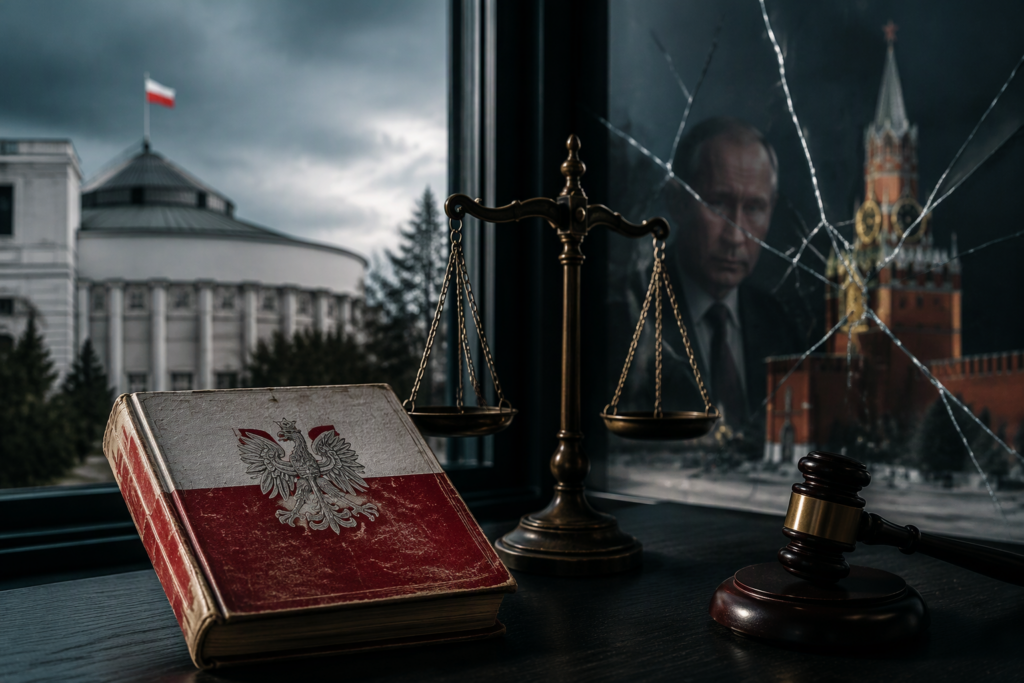

Riot police carrying shields and wearing helmets stood outside Poland’s highest constitutional court as judges inside fought for control of the bench. The standoff shows how rapidly the bitter Poland constitutional battle has escalated from courtroom arguments into physical confrontations in the heart of Warsaw.
This political war between the country’s two dominant camps is not just an arcane legal row. By turning state institutions into partisan weapons, both sides are eroding public faith in the republic at the exact moment a hostile superpower sits on the eastern border.
Also read: Russian Lawyer Maria Bontsler Jailed for 12 Years
For ordinary citizens, the spectacle deepens exhaustion. As inflation and daily living costs bite, the country faces a hot war in neighboring Ukraine alongside relentless Russian hybrid warfare designed to fracture national unity.
Helmets, shields and police at the tribunal doors
The latest clash erupted when a newly appointed judge ordered the suspension of the Constitutional Tribunal’s president and deputy president. Police officers quickly took up positions around the building during the operation, signaling that the fight had entered dangerous territory.
President Karol Nawrocki denounced the incident as a forcible takeover of the court. Nawrocki, who is aligned with the conservative Law and Justice party, insisted the intervention violated basic legal norms.
Prime Minister Donald Tusk took the opposite view, defending the police action as a necessary step to restore the rule of law. His coalition, uniting the centre-right Civic Platform and the liberal Left, claims it must clear out illegal appointees to repair the judiciary.
Yet the sight of armed officers at the court doors gave ammunition to critics. Dmitry Medvedev, the former Russian president, pounced on the showdown on November 3, publicly branding the intervention as a coup.
How both sides flipped their legal arguments
The origins of this dispute trace back to 2015, when the outgoing Civic Platform parliament attempted to appoint judges to vacancies reserved for the incoming legislature. When Law and Justice took power later that year, the party seized on the controversy to aggressively pack the court with its own loyalists.
A decade later, the two factions have completely traded roles. Law and Justice now urges its supporters to take to the streets to protect constitutional rights, using the exact slogans that liberals shouted during street protests ten years ago.
Meanwhile, Donald Tusk has adopted the persona of an uncompromising leader who prefers swift results over legal niceties. A photo of Tusk reading an issue of the journal Kronos dedicated to philosopher Carl Schmitt has spread widely across social media, drawing attention to Schmitt’s famous doctrine: “Sovereign is he who decides on the exception.”
Even some liberal-leaning legal scholars have voiced doubts about whether the coalition’s heavy-handed methods actually comply with the law. By acting outside strict statutory constraints, the current government risks mirroring the very behavior it spent years condemning.
Why the Poland constitutional battle plays into Moscow’s hands
When state institutions wage war against each other, the ultimate beneficiary is Vladimir Putin. Russian intelligence operations thrive on political polarization, using information campaigns to convince populations that democratic institutions are rigged and illegitimate.
Radical online influencers, drawing inspiration from Moscow and Beijing, have already begun framing the Polish state as little more than a tool of foreign occupation. The more the government uses exceptional powers to push back, the more evidence these extremists claim to have that the system is broken.
Poles are unlikely to pour into the streets by the millions this time. Most citizens see obvious hypocrisy in both political camps, and you can see why public patience has worn thin after a decade of legal warfare.
Instead of addressing border security or economic strain, Warsaw’s political elite remains consumed by institutional score-settling. The real damage is not just that one party controls the Constitutional Tribunal, but that citizens are losing their connection to the state itself.
The specter of a contested election
The most alarming risk is that this institutional decay could soon infect national elections. A troubling precedent occurred in Romania on December 6, 2024, when the Constitutional Court annulled a presidential election following intelligence reports of foreign interference, social media manipulation and irregular campaign financing.
Could the same crisis happen in Poland? If the political climate continues to deteriorate, a ruling establishment might use politicized courts to overturn election results by citing foreign digital interference.
In response, an increasingly anti-establishment opposition would reject the legitimacy of the entire system, claiming the vote was stolen. Because Russian hybrid warfare and digital meddling are genuine threats rather than invented excuses, distinguishing between lawful defense and political overreach becomes nearly impossible.
That cycle leaves democracy caught in a vise between hostile foreign algorithms and domestic emergency rule. The next major test comes when the country faces its next nationwide vote, where every contested ballot could trigger a complete breakdown of constitutional trust.
Source: Al Jazeera