
Terence Tao on AI in Mathematics: Why the Discipline Is a ‘Canary in the Coal Mine’
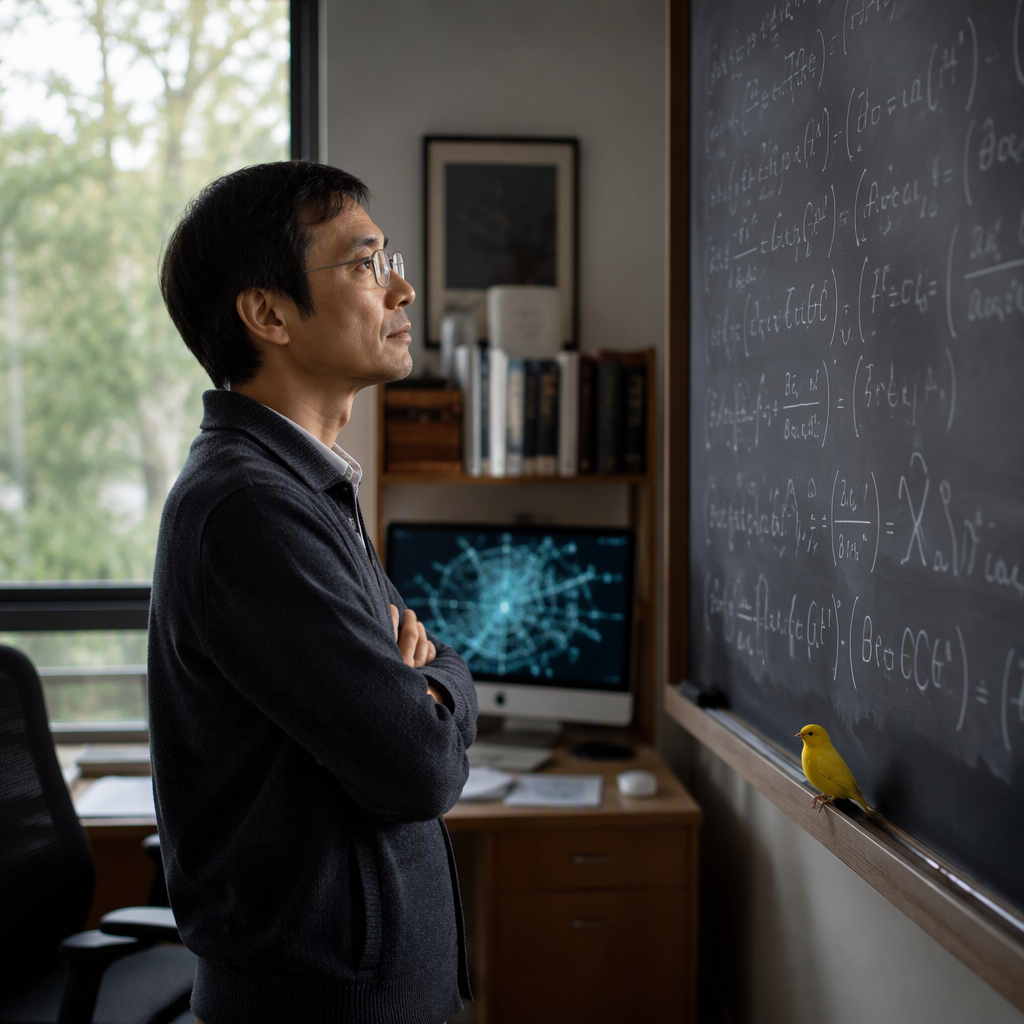
Fields Medalist Terence Tao believes mathematical research is serving as an early testing ground for the broader artificial intelligence revolution. Speaking on the rapid integration of machine learning tools in research, Terence Tao on AI in mathematics emphasized that the discipline acts as a “canary in the coal mine,” offering an early glimpse into how automated reasoning will disrupt complex human intellectual work.
Because mathematics relies on rigorous logic rather than subjective interpretation, Tao argues that the field provides an objective environment to test whether AI systems can handle long-horizon reasoning, avoid hallucinations, and generate genuine scientific breakthroughs.
Also read: Musk Explains Why SpaceX Restricted Ukraine Starlink Connection as Service Continues
The ‘Canary in the Coal Mine’ Metaphor Explained
In traditional mining, canaries alerted workers to dangerous, undetectable gases before disasters occurred. Tao applies this metaphor to artificial intelligence because mathematical proofs have definitive ground truth. A proposed proof is either logically sound or flawed, leaving little ambiguity.
In many fields, assessing AI-generated output requires dealing with ambiguity, tone, or subjective judgment. In contrast, pure mathematics allows researchers to verify machine output systematically. When an AI tool succeeds or fails in advanced mathematics, it reveals the fundamental strengths and limitations of underlying machine learning architectures.
“Math is a canary in the coal mine because it’s a domain where we can test these tools rigorously,” Tao noted during discussions on automated reasoning. If AI can navigate the unforgiving landscape of formal logic, it suggests that automated reasoning can soon expand into other high-consequence domains like software verification, circuit design, and legal analysis.
Formal Proofs and the Rise of AI Tools
Tao has been at the forefront of testing cutting-edge computational tools in mathematical workflows. Over the past two years, he has incorporated interactive theorem provers, such as Lean 4, alongside large language models (LLMs) to verify complex theorems.
A notable milestone came in late 2023, when Tao led an open-source collaboration that formalized a proof of the Polynomial Freiman-Ruzsa (PFR) conjecture in Lean in just a few weeks. The project demonstrated how automated systems, paired with crowdsourced human mathematicians, can accelerate the verification of cutting-edge research.
While generative models like ChatGPT still struggle with complex arithmetic and multi-step deduction on their own, hybrid approaches that combine LLMs with formal verification engines are closing the gap. Recent breakthroughs, including Google DeepMind’s AlphaProof and AlphaGeometry, showed systems solving International Mathematical Olympiad problems at a silver-medal standard.
Terence Tao on AI in Mathematics: What the Canary Signals
According to Tao, the early results emerging from this testing ground carry significant lessons for the broader tech sector. First, raw pattern matching without formal verification remains insufficient for advanced reasoning tasks.
Large language models alone frequently hallucinate plausible-sounding arguments that collapse under close scrutiny. However, when these models are coupled with interactive theorem provers that reject invalid steps, AI transitions from an unpredictable generator into an efficient research assistant.
Tao points out that the real challenge lies in long-chain reasoning. Human mathematicians break problems down into lemmas, abstractions, and strategic detours. For AI to truly master research-level mathematics, systems must evolve from generating immediate next tokens to developing high-level architectural plans for proofs.
Collaboration Rather Than Full Automation
Despite the rapid pace of change, Tao does not foresee mathematicians becoming obsolete in the immediate future. Instead, he envisions a transformed workflow where human researchers partner with digital collaborators.
In this near-future framework, humans will likely supply mathematical intuition, identify promising conjectures, and guide overall strategy. AI co-pilots will manage tedious calculations, search the mathematical literature for relevant lemmas, and formalize proofs into verifiable code.
This hybrid model could democratize research by lowering the barrier to verifying complex work and accelerating peer review, which currently takes months or years in academic journals.
What Happens Next
The pace of development in automated mathematical reasoning continues to accelerate. Major research institutions and artificial intelligence labs are pouring resources into neuro-symbolic AI—combining neural networks with symbolic logic systems.
In the coming years, mathematical bodies will likely need to establish standardized protocols for verifying AI-assisted proofs. As formal provers become faster and easier to use, the techniques refined in mathematics will migrate into commercial software engineering, autonomous systems, and scientific discovery pipelines.
Conclusion
The perspective of Terence Tao on AI in mathematics clarifies the trajectory of machine intelligence across analytical disciplines. By acting as the canary in the coal mine, mathematics is highlighting both the pitfalls of hallucination and the power of hybrid verification systems, demonstrating that the future of complex reasoning belongs to human-machine collaboration.