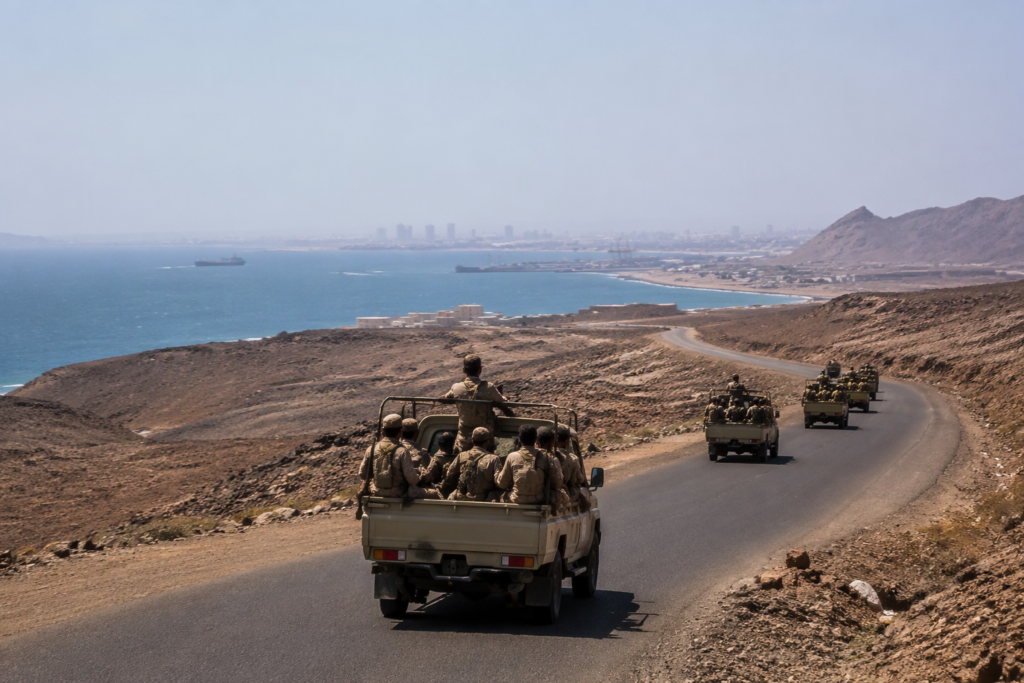
Yemeni troops have abandoned forward positions near the critical Bab al-Mandeb strait, pulling back southwest coastal units to shield their interim capital from an approaching Houthi offensive. The retreat leaves the waters connecting the Red Sea to global shipping lanes exposed as front lines shift rapidly toward Aden.
The pullout follows intense pressure on government lines across southern Yemen. Houthi forces have seized high ground north of Aden and openly declared preparations to march on the southern port city, which has served as the base for the internationally recognised government since fighters drove state leaders from Sanaa a decade ago.
Also read: Strait of Hormuz: 25 Seafarers Killed as Tanker Attacks Surge
For international cargo ships moving through the Red Sea and for civilians trapped across the south, the redeployment alters the entire military balance on the ground.
Withdrawal from the Bab al-Mandeb strait
A spokesperson for the Southern Armed Forces, allied with the Saudi-backed administration, confirmed on Sunday that troops vacated Dhubab airport and surrounding territory along the coast. Military leaders stated that their primary mission has shifted from holding trade corridors to surviving an assault on their home base.
“This step is taken based on the priority of securing the capital, Aden, and the neighbouring governorates, as well as strengthening the front lines and addressing existing threats,” the spokesman said.
The decision amounts to an admission that the counteroffensive launched in September has stalled. While that push briefly took back ground near the waterway, government units could not dislodge Houthi fighters from the fortified city of Mocha. Now, the vacated positions around the Bab al-Mandeb strait leave the coast vulnerable once more.
Government spokesperson Majid Al-Nazili urged foreign powers to intervene, warning that trade routes face renewed disruption if the maritime choke point falls completely under rebel sway.
Pressure mounts on Taiz and southern fronts
Commanders are not just shifting battalions to Aden. They are also diverting soldiers northeast to counter the grinding siege of Taiz, where heavy combat continues to rage west of the urban center.
Taiz is currently enduring a desperate humanitarian emergency. Rebel blockades prevent food and medical cargo from reaching neighborhoods, and trapped residents cannot flee through active combat zones. The city shelters roughly half of the 300,000 people displaced throughout the country since the 2022 nationwide ceasefire collapsed during the summer.
The pullout from coastal posts threatens to stretch government supply lines even thinner as commanders try to hold two distant fronts simultaneously.
Cross-border strikes and prisoner releases
The territorial shift follows weeks of escalating cross-border warfare. Ansar Allah has stepped up missile strikes and drone barrages into Saudi Arabia, hitting energy installations and forcing authorities there to ground commercial flights. On Sunday morning, the Saudi-led coalition announced it intercepted two explosive drones flying over the Mecca province.
Amid the fighting, unexpected diplomatic movements surfaced. The International Committee of the Red Cross facilitated the unilateral release of 600 prisoners freed by the Houthis on Sunday.
Yet that goodwill gesture did little to halt preparations on the battlefield. With government fighters now consolidating around urban checkpoints, the coming days will show whether defensive lines outside Aden can halt the rebel advance.
Source: Al Jazeera


