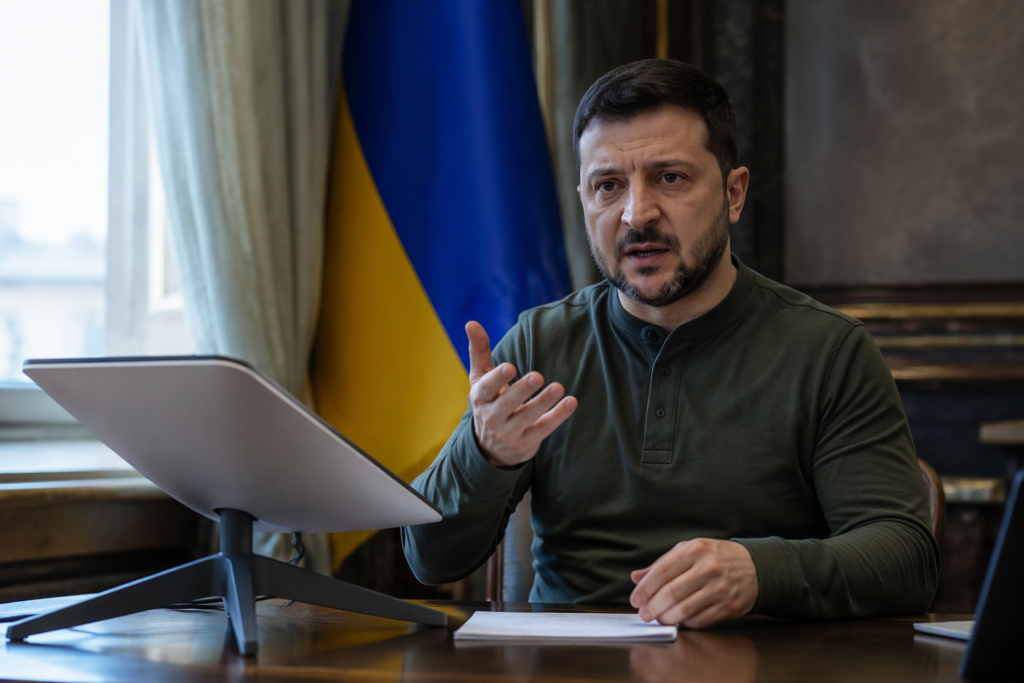
Ukrainian interceptor drones are losing connection with their operators the moment they hit 100 miles per hour, leaving skies open to Russian attacks because of unlifted Starlink restrictions. President Volodymyr Zelensky warned that the throttled speeds on the satellite network directly threaten civilian lives and power stations as winter sets in.
The issue centres on Starshield, a military-grade satellite communications system developed by Elon Musk’s SpaceX and supplied through the United States government. While regular Starlink terminals handle everyday battlefield communications, Starshield guides Ukraine’s airborne defense units to intercept fast-moving Russian drones. With those terminals slowed down along front lines and occupied zones, Ukrainian units cannot track incoming strikes in real time.
Also read: Blinken Warns Ground Invasion of Iran Means Disaster
For civilians across Ukraine, the timing could hardly be worse. Russian forces are striking power stations, rail hubs, and regional substations almost daily. If Kyiv cannot coordinate its defensive drones at full speed, millions face freezing temperatures without power or heating.
The front-line reality of Starlink restrictions
Zelensky made his appeal directly to Washington and Musk, urging both parties to remove the speed caps and stand on the right side of history. The Ukrainian president explained that interceptor drones suffer signal cutoffs at exactly 161 kilometers per hour (100 mph), rendering them incapable of catching Russian jet-powered Shahed drones modeled on Iranian designs.
“We are counting on these restrictions being lifted. The protection of lives and Ukraine’s energy infrastructure ahead of winter directly depends on this.”
The performance caps do not apply nationwide. According to Zelensky, the slowdown was enforced along front-line areas and Russian-occupied regions. That selective throttling creates an alarming diplomatic precedent, he argued, because applying arbitrary technical borders risks tacitly treating occupied Ukrainian territory as foreign soil.
A diplomatic blame game between Washington and Elon Musk
Who ordered the slowdown remains disputed. Elon Musk previously stated that the US government holds operational control over the Starshield service and bears responsibility for any limitations placed on it. Yet the White House maintains the administration played no role in the slowdown.
US President Donald Trump dismissed claims of federal involvement, stating he had no knowledge of the limits. Trump told reporters that when he spoke to Musk, he told the billionaire owner to put the service back to full speed. Even so, Ukrainian military units confirm the Starshield limitations remain active along combat sectors.
The standoff over Starlink restrictions also ties into disputes over Ukrainian strikes inside Russian territory. Trump criticized Ukrainian drone attacks against Russian oil refineries, arguing that hits on refining hubs have driven global crude prices higher. Kyiv insists those refinery strikes are necessary to choke off the Kremlin’s primary source of war financing.
Wave of strikes pummels power stations and rail lines
The communications handicap comes as Ukraine faces an acute shortage of US-made Patriot interceptors. Russian commanders have seized on Ukraine’s thinned air defense stocks to step up saturation strikes across the country.
Recent bombardments hit energy facilities across Zaporizhzhia, Sumy, Odesa, Zhytomyr, and Kirovohrad. Russian missiles also damaged critical railway infrastructure in Dnipro, Kharkiv, and Zaporizhzhia, leaving dozens wounded. In the northern Chernihiv region, governor Vyacheslav Chaus confirmed two people died when strikes slammed into an infrastructure site in the town of Mena.
Ukrainian forces struck back deep behind enemy lines despite the front-line terminal caps. On November 15, defense units launched long-range strikes against a petrochemical complex and an oil refinery in Nizhnekamsk, located in Russia’s Tatarstan region. Kyiv identified both sites as industrial backbones feeding raw fuel to the Russian military.
Cross-border fire also struck the Russian port city of Taganrog, where regional governor Yuri Slyusar reported one fatality. In the Russian-occupied Luhansk region, Moscow-installed official Leonid Pasechnik said strikes killed two civilians, including a truck driver and an elderly woman.
Baltic tensions surge over hybrid sabotage
The friction over Starlink restrictions and air defense comes amid growing hybrid security concerns across Eastern Europe. Estonia revealed that it will shut all border crossing points with Russia starting on December 1, following a thwarted attack on its domestic defense industry.
Estonian authorities arrested eight individuals suspected of planning an arson attack against Threod Systems, a prominent drone manufacturer. Investigators in Tallinn stated the suspects acted under direct orders from Russia’s GRU military intelligence agency.
Estonian Foreign Minister Margus Tsahkna warned that Moscow’s hostile actions on NATO soil will draw clear consequences. All eyes now turn to whether the US Department of Defense and SpaceX will quietly restore full-speed Starshield access before sub-zero winter temperatures freeze Ukraine’s battered power grid.
Source: BBC


