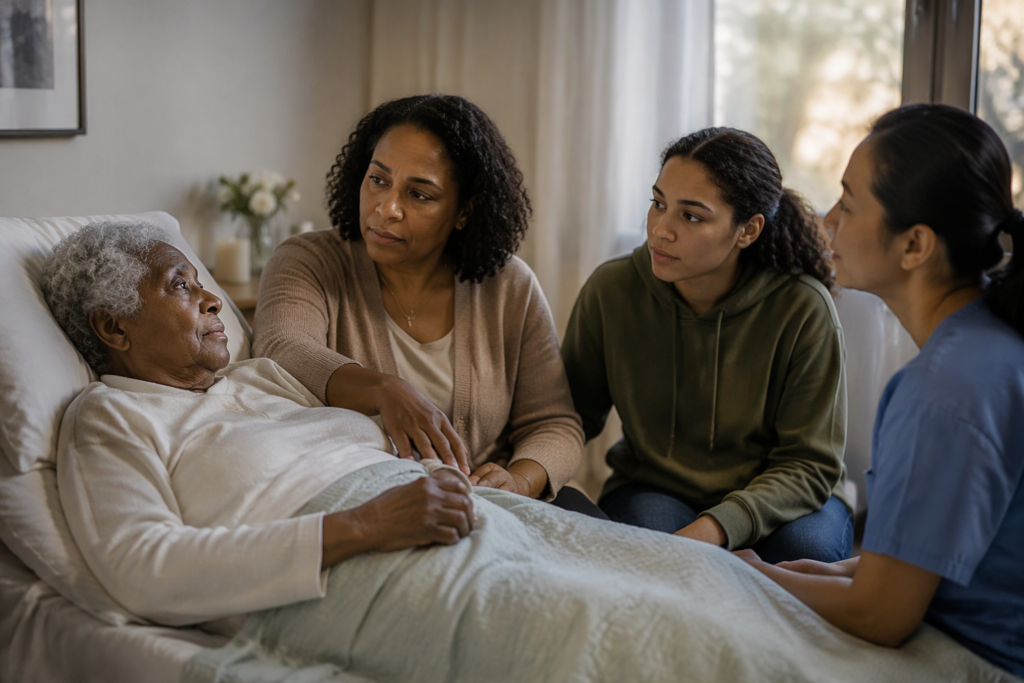
When a dying Hindu patient lay in an English hospital bed, medical staff sent an Imam into the room to minister to him. That basic misunderstanding shows the stark disconnect facing ethnic minority families at the bedside, according to new research into end-of-life care.
A study led by King’s College London and the University of Sheffield reveals that minority ethnic patients and their families regularly struggle to get culturally and religiously appropriate help when facing death and grief. Instead of receiving comfort, families often find an inflexible healthcare system that leaves them feeling isolated at their most vulnerable moment.
Also read: Alzheimer’s Blood Marker Predicts Cognitive Decline in Mayo Study
These systemic shortfalls mean that basic dignity and tailored palliative care often depend on a patient’s heritage, leaving many to navigate grief without professional backing.
Gaps in end-of-life care across UK hospitals
Researchers uncovered multiple tiers of inequality embedded within current medical practice. Sabrina Bajwah, one of the study’s co-authors, pointed out that a generic approach to medicine often does direct harm.
“There was the structural racism that people talked about, which was the ‘treating everybody equally’ – and by treating everybody equally, services weren’t meeting the needs of these communities,” Bajwah explained. “Then there was the other, direct form of racism.”
These experiences align with findings released last year by the NHS Race and Health Observatory, an independent body established in 2021 to examine healthcare inequalities. That investigation revealed an alarming lack of trust in health services, with just over half of minority participants reporting they had encountered NHS discrimination while receiving treatment.
Delayed diagnosis and overlooked traditions
For Pravin Navekar and his late wife Gita, cultural barriers and institutional disinterest showed up years before her death. Gita began suffering severe back and leg pain in Leicester in 2010. For two years, general practitioners repeatedly sent her home with basic painkillers instead of arranging scans.
Desperate for answers, the couple paid out of pocket to see a private consultant, who immediately ordered a CT scan. The imaging revealed synovial sarcoma, a rare cancer growing in her pelvis. While clinicians gave her less than five years to live, Gita survived for 11 years before dying in April 2021.
During her stays on NHS wards, staff routinely overlooked basic elements of her identity. Pravin watched the hospital deck corridors for Christmas, while autumn festivals like Diwali passed without a single word of recognition.
“It’s about recognising a person as a whole person, rather than somebody in a bed who needs care.”
Grassroots networks filling the gap
When state systems fail, families frequently rely on grassroots mutual aid to manage tragedy. Marwa Soliman experienced that isolation firsthand when her father died in 2013, shortly after she moved from Egypt to Nottingham while pregnant with her third child. Without family or community around her, she broke down alone on the floor.
Six years later, Soliman founded Heya, an Arabic term meaning “she,” to provide dedicated bereavement support for Arabic-speaking Muslim women. The initiative began with 50 members and has grown to more than 700. When a member loses a loved one, the network coordinates visits, prepares meals, reads the Quran together, and sends condolences.
Having Heya made all the difference when Soliman later lost three other close relatives, including her mother. But she points out that funding for grassroots bereavement groups remains sparse, and clear referral routes from hospitals do not exist.
What ministers plan to do next
Health officials now face pressure to incorporate community groups directly into palliative planning. Catriona Mayland, a co-author from the University of Sheffield, argued that medical providers should partner with existing volunteer organizations rather than try to build separate systems from scratch.
The Department of Health and Social Care, which funded the academic study, insisted that background should never prevent someone from receiving high-quality end-of-life care. Officials stated they will examine the report’s recommendations closely as they draft upcoming health policy guidance.
Source: BBC