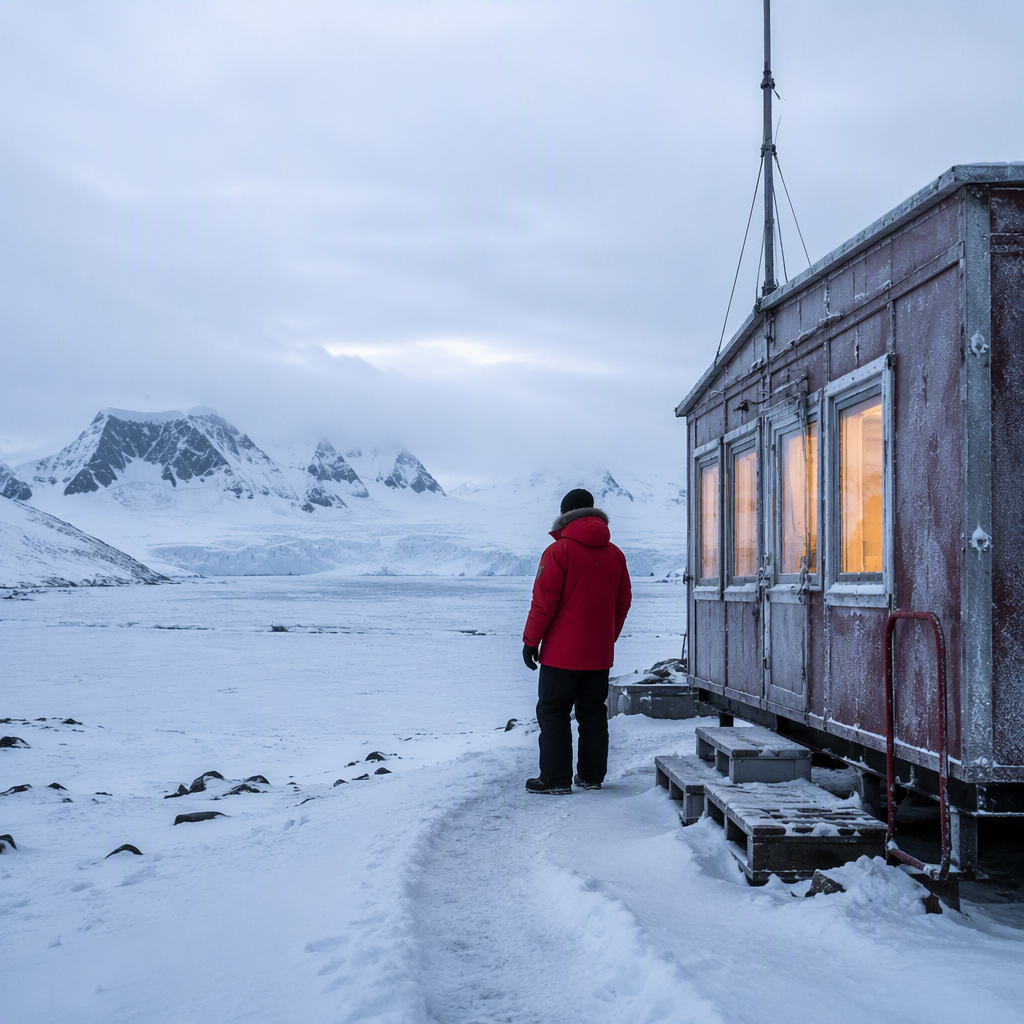

Life in a Remote Station at the Edge of the World: How Crews Survive Extreme Isolation
Thousands of miles from the nearest commercial hub, human endurance meets scientific ambition in the most inhospitable environments on Earth. Understanding life in a remote station at the edge of the world requires looking past romantic ideas of polar exploration to examine the rigorous daily routines, intense psychological pressures, and vital scientific output of small winter-over crews stationed in Antarctica and the high Arctic.
From the high-altitude plateau of Concordia Station to the coastal outposts of Svalbard and northern Greenland, these isolated research facilities operate as self-contained micro-societies. As climate change accelerates, the data collected at these distant borders provides critical insights into global weather systems, ocean currents, and planetary history.
Also read: UK to Invest £100m in World-First AI Biosecurity Lab
Surviving the Elements: Daily Realities of Extreme Outposts
Living at extreme latitudes requires constant vigilance against freezing temperatures, catastrophic winds, and environmental hazards. At stations like the Amundsen-Scott South Pole Station, winter temperatures routinely plunge below minus 70 degrees Celsius (minus 94 degrees Fahrenheit), turning routine maintenance runs into life-threatening operations.
Daily life revolves around strict protocols designed to preserve life and infrastructure:
- Mechanical maintenance: Station engineers monitor backup power generators, air filtration units, and water production systems continuously to prevent catastrophic failure.
- Rationed resources: Water melting consumes substantial fuel, forcing crew members to limit personal water usage and adhere to strict rationing schedules.
- Protective gear: Stepping outside demands multi-layered thermal suits, face coverings, and radio check-ins, even for journeys lasting only a few minutes.
Every resource, from preserved food to spare mechanical valves, must arrive during short summer resupply windows. Once transport flights cease for the winter months, no evacuation or resupply is possible until spring.
The Psychological Toll of Isolation and the Polar Night
Beyond sub-zero temperatures, confinement remains the greatest test for station personnel. During the polar night, the sun remains below the horizon for months, disrupting natural circadian rhythms and contributing to sleep disturbances, lethargy, and psychological fatigue commonly known as the “winter-over syndrome.”
Space agencies such as NASA and the European Space Agency (ESA) treat these outposts as ground-based analogues for future deep-space missions to the Moon and Mars. Psychologists monitor how small, diverse teams manage interpersonal conflict when external contact is strictly limited.
To preserve mental health, station managers emphasize structured daily schedules, shared community meals, recreational activities, and gym routines. Maintaining communal morale is an operational necessity, as team cohesion directly affects safety protocols.
Why Science Depends on Life in a Remote Station at the Edge of the World
The arduous nature of sustaining life in a remote station at the edge of the world is justified by the peerless scientific data these outposts produce. Far removed from urban light, air, and electromagnetic pollution, polar stations offer pristine conditions for several critical disciplines:
- Climate science: Ice core drillers retrieve deep samples that reconstruct Earth’s atmospheric composition and temperature fluctuations over hundreds of thousands of years.
- Astrophysics: Telescopes stationed in cold, dry polar environments capture exceptionally clear observations of deep space and cosmic microwave background radiation.
- Seismology and meteorology: Remote sensors feed international monitoring networks, tracking global tectonic shifts, atmospheric circulation, and ozone layer recovery.
Without the dedication of winter-over technicians who monitor these instruments around the clock, long-term observational records that inform global climate policy would feature significant gaps.
Modern Technology and Connectivity: Bridging the Divide
Recent technological advancements have begun transforming the polar experience. Low-Earth-orbit satellite constellations now provide higher bandwidth and lower latency, replacing the intermittent communications that isolated polar workers in previous decades.
Crew members can now participate in real-time video calls with family, download medical telehealth consultations, and transmit large research datasets immediately. However, polar veterans note that improved connectivity brings mixed results. Constant digital links can tether researchers to the stresses of the outside world, subtly fracturing the communal solidarity that traditional isolation once fostered.
What Happens Next for Polar and Deep-Field Research
National research programs are modernizing stations to reduce fossil fuel dependency and bolster logistical resilience. Projects incorporating hybrid wind-solar systems, automated sensors, and improved waste-recycling systems are underway across Antarctica and the Arctic.
Furthermore, international science bodies are increasing the use of autonomous underwater vehicles and unmanned monitoring stations to reduce human footprints in delicate biomes. Despite rising automation, complex maintenance, scientific drilling, and unexpected fieldwork will keep human crews stationed at the ends of the Earth for decades to come.
Conclusion
Enduring life in a remote station at the edge of the world demands exceptional physical resilience, technical competence, and emotional balance. These quiet outposts remain vital outposts of discovery, demonstrating how human cooperation under extreme pressure can unravel the deepest mysteries of our planet.




1 Comment
Comments are closed.