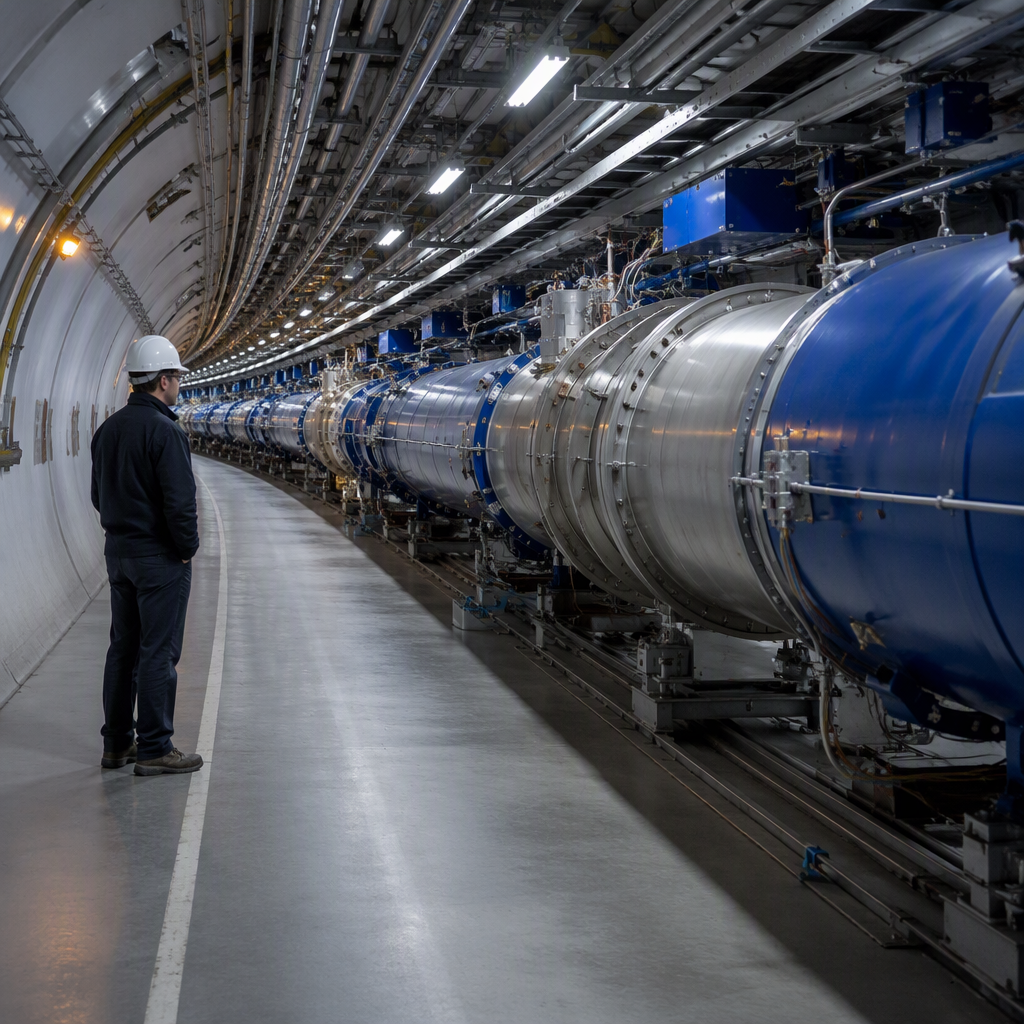

Particle Accelerators: How Next-Gen Physics Machines Are Reshaping Science and Medicine
Particle accelerators have evolved far beyond theoretical physics laboratories, emerging as indispensable engines for medical breakthroughs, industrial manufacturing, and next-generation energy solutions. While facilities like CERN’s Large Hadron Collider dominate headlines for probing fundamental cosmic forces, thousands of smaller accelerators worldwide are quietly transforming everyday technology and clinical care.
Today, researchers and engineers are pushing the boundaries of particle acceleration. Through novel techniques like plasma-wakefield acceleration and high-temperature superconducting magnets, the global scientific community is working to make these massive instruments smaller, cheaper, and exponentially more powerful.
Also read: Solar Power Surpassing Nuclear: How Plunging Costs Are Reshaping Global Energy
Unlocking the Subatomic Universe
At their core, particle accelerators use electromagnetic fields to propel charged particles—such as protons, electrons, or ions—to speeds approaching the speed of light. When these particles collide or interact with targets, they release massive amounts of energy and reveal subatomic structures that cannot be observed through conventional means.
The Large Hadron Collider (LHC) near Geneva remains the most prominent example, famously confirming the existence of the Higgs boson in 2012. Currently operating in its third major run, the LHC continues to explore elusive phenomena, including the nature of dark matter, antimatter asymmetry, and potential extensions to the Standard Model of particle physics.
From Fundamental Physics to Practical Healthcare
While deep physics discoveries make history, the everyday utility of particle accelerators is centered heavily in healthcare. More than 30,000 accelerators operate around the globe, and roughly one-third serve medical purposes.
Linear accelerators (linacs) are the standard tool in modern radiation oncology, delivering precise high-energy X-rays directly to malignant tumors while sparing nearby healthy tissue. In recent years, advanced facilities have scaled up proton and heavy-ion therapy.
Proton therapy uses targeted charged particles that deposit the bulk of their destructive energy precisely within the tumor margin—an effect known as the Bragg peak. This precision significantly reduces collateral radiation damage, making it a critical tool for treating pediatric cancers and tumors situated near vital organs.
Synchrotron Light: Illuminating Materials and Biology
Beyond direct particle collisions, accelerators generate intense electromagnetic radiation known as synchrotron light. Circular accelerators called synchrotrons accelerate electrons to produce ultra-bright beams of infrared, ultraviolet, and X-ray light.
Scientists direct these beams into specialized experimental stations to examine materials at atomic resolution. Structural biologists routinely use synchrotron light sources to map complex viral proteins and design targeted pharmaceuticals, an approach instrumental in the rapid development of antiviral treatments and vaccines.
Materials scientists also rely on synchrotrons to analyze battery chemistry in real time, inspect semiconductor chips for micro-defects, and study ancient artifacts without causing physical damage.
Next-Gen Particle Accelerators: Smaller, Stronger, Greener
Traditional high-energy accelerators require miles of underground tunnels and immense electrical power. To address these physical and financial constraints, scientists are pursuing compact accelerator designs.
Plasma-wakefield acceleration represents one of the most promising frontiers. By driving an ultra-short laser pulse or particle bunch through ionized gas (plasma), researchers create intense electric fields thousands of times stronger than those in conventional radio-frequency cavities. This breakthrough allows particles to gain gigavolt-scale energies over centimeters rather than kilometers, potentially democratizing access to high-energy physics tools for university labs and regional hospitals.
What Happens Next
Major international collaborations are already planning the next decade of infrastructure investments. CERN is advancing its High-Luminosity LHC upgrade, designed to increase collision rates by a factor of ten by the late 2020s. Long-term feasibility studies are also underway for the Future Circular Collider (FCC), a proposed 91-kilometer ring intended to push collision energies beyond 100 teraelectronvolts.
Concurrently, national laboratories in the United States, Europe, and Asia are scaling up laser-driven compact prototypes and investing in energy-recovery linacs to reduce operational carbon footprints. As public-private partnerships expand, industrial adoption of compact beam systems for semiconductor lithography and nuclear waste mitigation is expected to grow rapidly.
Conclusion
Modern particle accelerators represent far more than tools for abstract academic inquiry. From discovering the building blocks of reality to curing complex cancers and engineering advanced materials, these machines remain vital catalysts for global innovation. As miniaturization technologies mature, the impact of particle accelerators on society and industry will only accelerate.