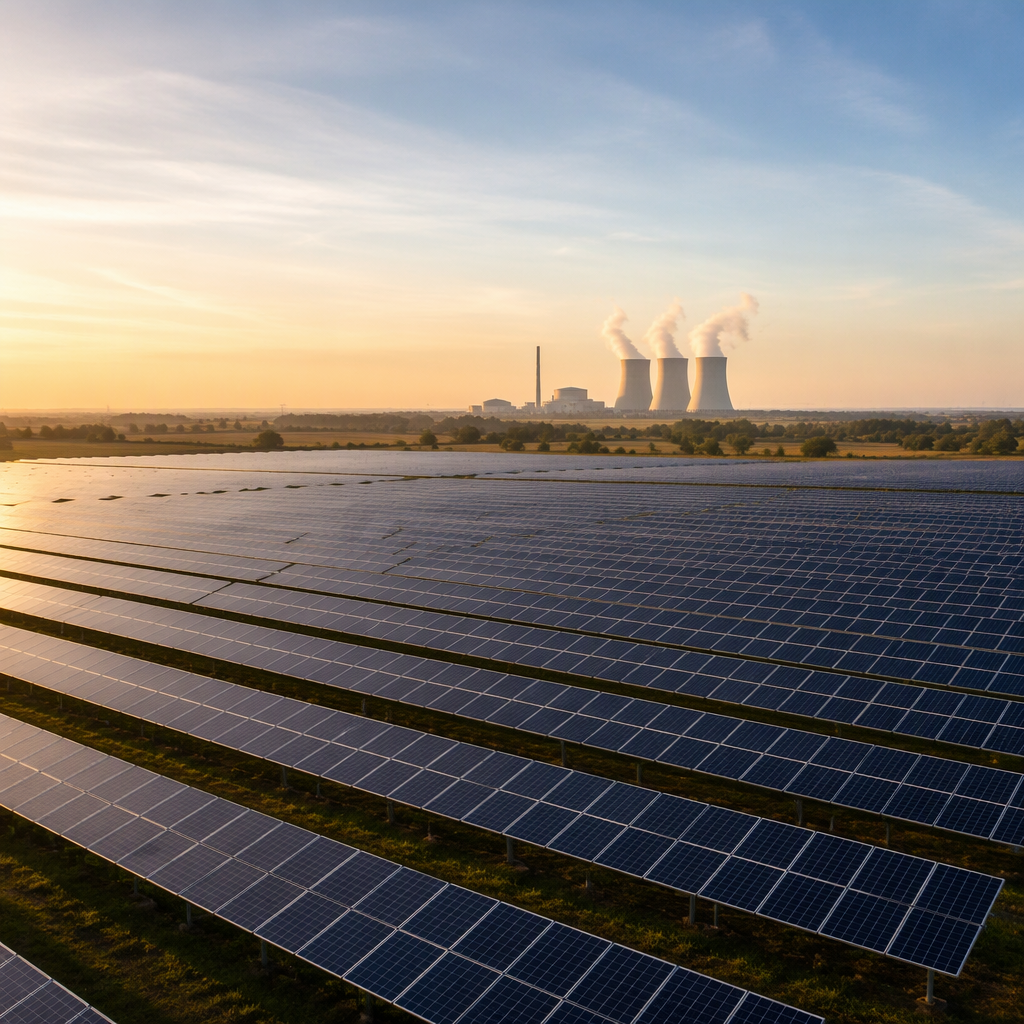

Plunging hardware costs and unprecedented installation rates have set the global energy transition on a dramatic trajectory, with solar power surpassing nuclear energy benchmarks at a pace few forecasters anticipated a decade ago. Driven by plummeting module prices that energy analysts now describe as “offensively cheap,” solar photovoltaics have transitioned from an alternative technology into the primary engine of global electricity expansion.
According to data from the International Energy Agency (IEA) and BloombergNEF, global investments in solar generation now exceed spending on all other electricity generation technologies combined. While nuclear power continues to supply reliable, low-carbon baseload electricity, its sluggish construction timelines and massive capital expenditures stand in stark contrast to the modular, rapid deployment of solar farms worldwide.
Also read: Solar Power vs Nuclear: How Cheap Solar Is Eclipsing Atomic Energy
The Collapse in Solar Costs: Why Panels Are ‘Offensively Cheap’
The core catalyst behind this historic shift is straightforward economics. Over the past four decades, the cost of solar photovoltaic modules has plummeted by more than 99 percent. In the past two years alone, an aggressive expansion of manufacturing capacity—predominantly centered in China—triggered an oversupply that drove module prices below $0.10 per watt.
This drop has dramatically lowered the Levelized Cost of Electricity (LCOE) for utility-scale solar. Industry financial benchmarks from firms like Lazard place the unsubsidized cost of new utility-scale solar between $28 and $60 per megawatt-hour (MWh). In contrast, newly built nuclear power plants routinely face LCOE estimates between $140 and $220 per MWh, weighed down by stringent regulatory regimes, customized engineering, and multi-year financing expenses.
Because solar panels can be manufactured in automated gigafactories and deployed on rooftops or open land in months rather than decades, developers and utilities are deploying capital where returns are fastest and risk is lowest.
Capacity Versus Generation: Closing the Nuclear Gap
In terms of total nameplate capacity, solar eclipsed nuclear several years ago. Global installed solar capacity crossed the 1.6-terawatt (TW) threshold in 2023 and continues to add hundreds of gigawatts annually, whereas operational nuclear capacity has remained relatively static at approximately 375 to 400 gigawatts (GW) globally.
Historically, nuclear proponents pointed out that capacity does not equal actual generation. Nuclear reactors operate at capacity factors exceeding 90 percent, running continuously day and night. Solar arrays, limited by nighttime hours and cloud cover, typically operate at capacity factors between 15 and 25 percent.
However, the sheer volume of new solar installations is now overwhelming that mathematical difference. In 2024, global solar electricity generation approached parity with nuclear power’s total annual output of roughly 2,600 terawatt-hours (TWh). Energy analysts project that within the next two years, annual electricity generated from solar arrays will permanently surpass the global output of commercial nuclear reactors.
How Solar Power Surpassing Nuclear Highlights Shifting Utility Priorities
The dynamic of solar power surpassing nuclear generation illustrates a broader transformation in how utilities and grid operators plan for future demand. Modern energy markets prioritize short lead times and scalable investments.
Large-scale nuclear projects in Western nations have repeatedly suffered from multi-billion-dollar cost overruns and protracted delays. Recent landmark developments, such as the Vogtle expansion in the United States and the Hinkley Point C project in the United Kingdom, took well over a decade to complete or remain under construction, costing billions more than initial projections.
Meanwhile, solar projects can be planned, permitted, and commissioned in one to three years. Even when factoring in the cost of four-hour lithium-ion battery storage systems to shift solar energy into evening hours, combined solar-plus-storage installations frequently beat new nuclear on price and delivery schedules.
The Remaining Challenges: Intermittency and Grid Congestion
Despite solar power’s exponential growth, integration challenges remain substantial. Because solar production peaks during the middle of the day, wholesale power prices in regions with high solar penetration, such as California and parts of Western Europe, increasingly plunge into negative territory during afternoon hours.
Grid bottlenecks present another major hurdle. Thousands of gigawatts of renewable projects currently languish in interconnection queues worldwide, waiting for transmission infrastructure upgrades. Furthermore, during prolonged periods of dark, windless winter weather—known as “dunkelflaute”—solar output drops significantly, reinforcing the argument made by nuclear advocates that firm, weather-independent clean generation remains vital for national energy security.
What Happens Next
Governments and major technology firms are pursuing multi-track strategies. While tech giants invest in small modular reactors (SMRs) and lifetime extensions for existing nuclear stations to power artificial intelligence data centers, their near-term electricity demands are being met almost entirely by contracting massive solar and battery portfolios.
In conclusion, the trajectory of solar power surpassing nuclear highlights how market fundamentals dictate the pace of the global energy transition. As manufacturing scale pushes solar and battery costs even lower, solar generation is moving from a supplemental renewable source to the backbone of the world’s newly built electrical capacity.




1 Comment
Comments are closed.