
Inside the High-Tech Mission to Preserve a 17th-Century Shipwreck
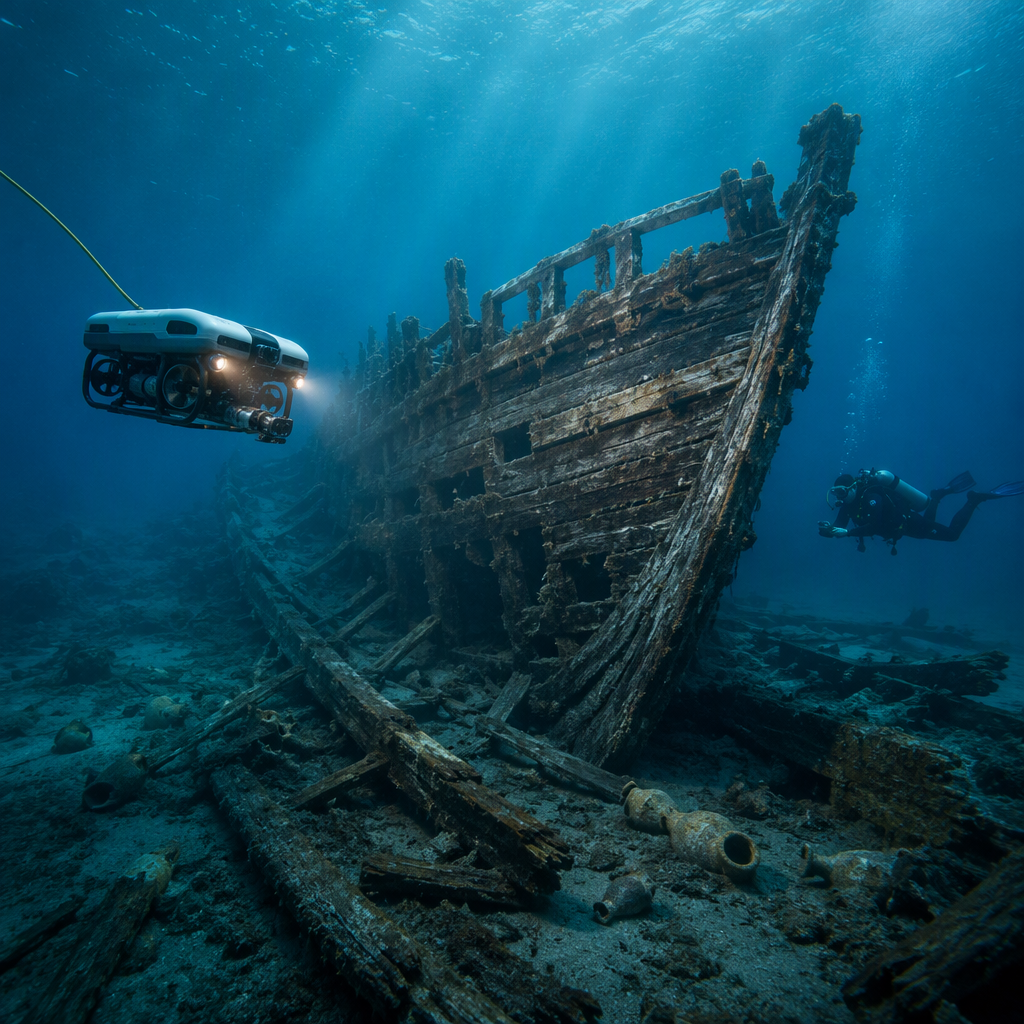
Marine archaeologists, conservators, and ocean engineers have joined forces in an ambitious international effort to preserve a 17th-century shipwreck using cutting-edge digital mapping, underwater robotics, and advanced material science. The delicate wooden vessel, submerged for over three centuries, faces accelerating threats from ocean acidification, warming waters, and microbial degradation, prompting scientists to implement unprecedented intervention methods.
The mission represents a turning point in maritime archaeology. Rather than relying on traditional physical excavation methods that can inadvertently damage fragile waterlogged timber, researchers are deploying non-invasive technologies to safeguard the historical relic both in situ and for museum-level archival records.
Also read: How the Immortal Jellyfish Could Unlock New Treatments for Diseases of Old Age
Advanced Robotics and Digital Mapping at Depth
Autonomous underwater vehicles (AUVs) and remotely operated vehicles (ROVs) equipped with ultra-high-definition cameras and sub-bottom acoustic profilers lead the offshore investigation. These submersibles navigate within inches of the hull, capturing hundreds of thousands of high-resolution images to create a millimeter-accurate “digital twin” of the vessel.
Through photogrammetry and acoustic LiDAR, scientists can visualize structural weaknesses, identify hidden cargo within sediment, and track shifting ocean currents around the wreck site. This non-destructive documentation ensures that even as the physical vessel endures natural decay, its exact structural geometry is preserved digitally in perpetuity.
High-Tech Solutions to Preserve a 17th-Century Shipwreck
The core challenge in any effort to preserve a 17th-century shipwreck lies in the chemical vulnerability of centuries-old oak and pine. When wood remains submerged in low-oxygen marine environments, cellulose breaks down, leaving only fragile lignin supported by water. Exposure to oxygen or physical disturbance causes rapid collapse.
To combat this, biochemical specialists are testing targeted biocides and bio-mineralization sprays designed to strengthen the wood fibers underwater. In sections selected for controlled recovery, conservators use specialized polyethylene glycol (PEG) consolidation baths and localized vacuum freeze-drying techniques. These processes displace trapped water molecules with stabilizing polymers, preventing the timber from warping or crumbling upon contact with air.
Combating Climate Change on the Seabed
Rising seabed temperatures and shifting salinity gradients have accelerated microbial activity, exposing the wreck to wood-boring organisms such as shipworms (Teredo navalis). These pests, historically restricted to warmer southern waters, are migrating into previously protected northern marine zones.
To shield the exposed timber, the conservation team has engineered custom protective barriers made of breathable geotextile mesh and localized sand deposits. These barriers stabilize local sediment, reduce current scouring, and create anoxic micro-environments that starve wood-degrading bacteria without altering surrounding marine habitats.
What Happens Next
The team is preparing to complete the final phase of the digital scanning campaign before seasonal winter storms disrupt sea operations. In the coming year, researchers will launch a public virtual-reality exhibit based on the 3D model, allowing historians, students, and the public to explore the shipwreck interactively without disturbing the physical site.
Monitoring stations installed directly on the seabed will continue transmitting live telemetry, including dissolved oxygen levels, pH balance, and structural vibration data, directly to research labs on shore.
Conclusion
The race to preserve a 17th-century shipwreck highlights how modern technology can bridge the gap between historical heritage and deep-sea science. By combining autonomous robotics, computational modeling, and specialized chemical engineering, researchers are establishing a new global benchmark for protecting irreplaceable maritime treasures before time and changing oceans erase them forever.


1 Comment
Comments are closed.