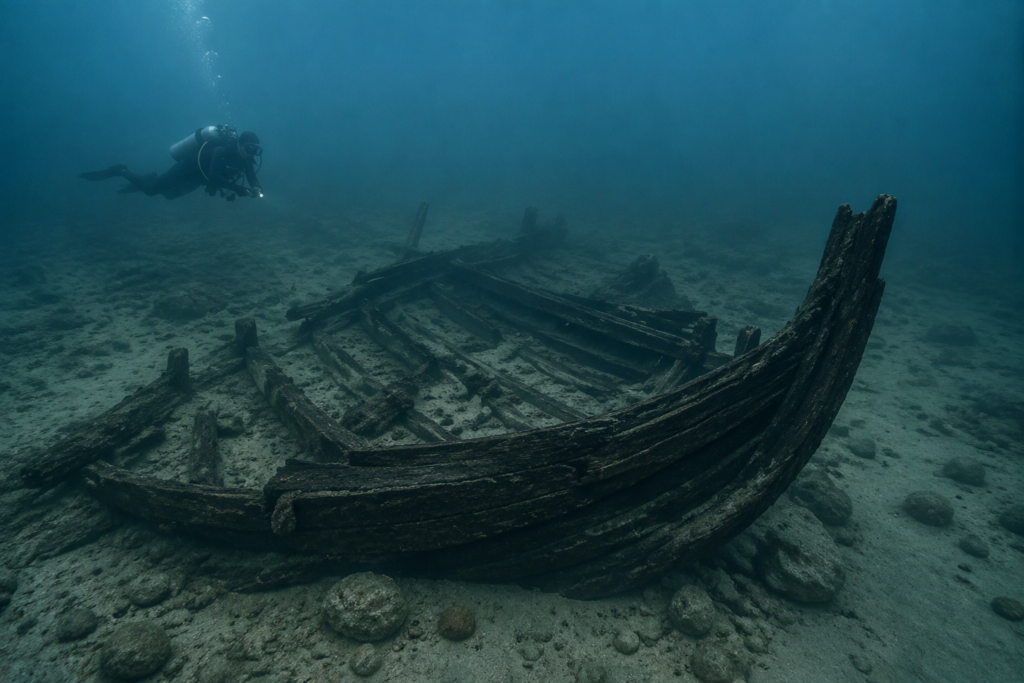

To pull five waterlogged vessels out of the seabed after nine centuries underwater, archaeologists in 1962 did not simply dive down to retrieve the Danish Viking ships. Instead, they built a wall in the open water and drained the sea.
The wrecks had rested beneath a Danish fjord for more than 900 years, buried in silt that kept oxygen away from their fragile timbers. The excavation of five ships at once gave researchers an unprecedented opportunity to examine northern maritime engineering from the era when Scandinavian seafarers dominated northern European waterways.
Also read: Ukraine Peace Talks in Abu Dhabi Put Kyiv on the Defensive
Exposing waterlogged wood to open air can destroy ancient timber within hours if it dries out too fast. That meant the recovery had to run with surgical precision, turning a coastal waterway into an open-air archaeological laboratory.
Draining the sea to reach Danish Viking ships
Standard marine salvage methods would have crushed the soft, decaying hulls. To solve the problem, engineering teams constructed a special dam straight out into the middle of the fjord, walling off the exact zone where the sunken fleet rested.
By draining the fjord within the enclosure, industrial pumps cleared away millions of gallons of water. The muddy seabed lay exposed to sunlight for the first time since the eleventh century, allowing workers to walk directly along the outlines of each hull.
Working on the Danish Viking ships meant treating every fragment like glass. Rather than hauling the structures out in heavy pieces, specialists had to inspect and secure each beam right where it had settled.
Student crews and the race against decay
The delicate physical labor fell largely to university recruits who spent their summer knee-deep in gray sludge. Girth Lerche was among the students who stepped into the drained seabed to help clear the sediment.
Crews used small tools and their bare hands to feel through thick mud, tracing fragile ribs without snapping the soft wood beneath. Even a misplaced step risked splitting a hull that had survived intact since medieval times.
Lerche later recounted her memories of that summer to broadcaster Tim O’Callaghan, recalling the intense concentration and physical grit needed to uncover the submerged relics piece by piece.
From seabed mud to permanent preservation
Keeping the ancient wood from collapsing required teams to keep the timbers wet until chemical preservation could begin. Specialists sprayed the timbers constantly to prevent air from shrinking the planks.
Each timber was cataloged, tagged, and carefully lifted for transport. The recovery of the Danish Viking ships marked one of the most complex maritime operations of its era, pioneering modern underwater archaeology methods.
Those recovered fragments were later stabilized and displayed through work associated with the Viking Ship Museum, which reconstructed the distinct profiles of the Viking age boats. Decades later, historians still consult the structural data gathered from those five hulls to understand early Nordic shipbuilding.
Conservators continue to monitor the surviving timbers in climate-controlled conditions to protect the medieval wood from environmental degradation.
Source: BBC