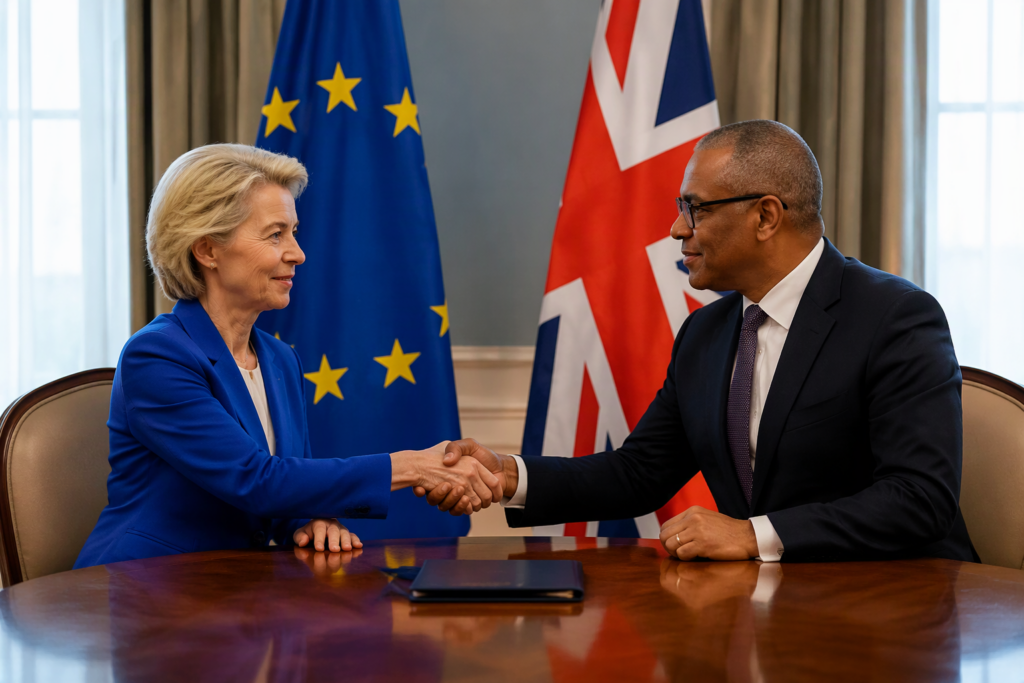
A decade after Britain voted to quit the European Union, Prime Minister Andy Burnham has struck a pact with Brussels across travel, carbon pricing, and food trade.
The breakthrough EU UK reset deal concludes months of closed-door diplomacy and establishes formal timetables to reconnect broken ties. Downing Street confirmed the diplomatic milestone on Friday afternoon following high-level summit talks in the Belgian capital.
Also read: Murders in South Africa Claim Nearly 600 Women in Three Months
If you are a student wanting to live abroad or a business moving fresh goods across the Channel, this agreement alters your horizon. It restores structured cooperation between the two sides after ten years of political drift.
What the EU UK reset deal covers
Negotiators zeroed in on three policy areas that created the steepest friction after Brexit. Both sides settled on concrete schedules to carry out reforms in each sector.
The agreed package focuses on three clear files:
- A youth mobility scheme to help young citizens work and study across borders
- A sanitary and phytosanitary agreement to ease plant and animal health checks at ports
- A formal link between British and European emissions trading systems
The EU UK reset deal establishes a common framework on carbon markets, helping industries on both sides align climate costs. Details outlining the exact mechanisms will appear in a joint statement scheduled for release soon.
Breaking the freeze at the Brussels summit
The breakthrough occurred during bilateral talks at a Brussels summit on Friday. UK officials described the conclusion of the talks as the opening chapter of a broader rapprochement.
Downing Street announced that negotiating teams completed discussions across the three selected policy areas. The agreement closes a decade of persistent dispute over trade friction and border barriers that followed the 2016 referendum.
What Downing Street said after the talks
British officials emphasized that technical bargaining has wrapped up, moving the accord into its operational phase.
The deal is done – negotiations have concluded. Now, both sides will work towards implementation.
A UK government spokesperson confirmed that domestic legal mechanisms must now take over in London and European capitals. The spokesperson added that dialogue will continue on other unresolved policy areas.
Ratification votes and future talks
Reaching an understanding in Brussels does not make these measures immediate law. Officials in Britain and across EU member nations must guide the text through standard constitutional and parliamentary approvals.
Expect the joint statement in the coming days to reveal the exact start dates for youth mobility permits and simplified food inspection rules. All eyes now turn to the House of Commons and European institutions for the opening ratification debates.
Source: Al Jazeera


