
Outposts and Impunity: The Anatomy of Israeli Settler Land Grabs in the West Bank
Across the rolling hills of the occupied West Bank, a systematic pattern of displacement has accelerated significantly over the past two years. At the center of this territorial transformation are Israeli settler land grabs, an interconnected system combining unauthorized pastoral outposts, physical intimidation against Palestinian rural communities, and widespread legal impunity documented by international observers and human rights groups.
According to data from the United Nations Office for the Coordination of Humanitarian Affairs (OCHA), hundreds of Palestinians have been displaced from rural grazing communities since late 2023 alone, leaving behind vast tracts of grazing land that have swiftly been absorbed by nearby unauthorized settlement outposts.
Also read: Israeli Forces Turn Hebron Homes into Military Posts Amid West Bank Lockdown
The Mechanics of Pastoral Outposts
While formal settlements are planned, state-approved residential developments, outposts are established without official government authorization under Israeli law. In recent years, a strategic shift has taken place from constructing densely populated residential clusters to establishing agricultural and pastoral outposts.
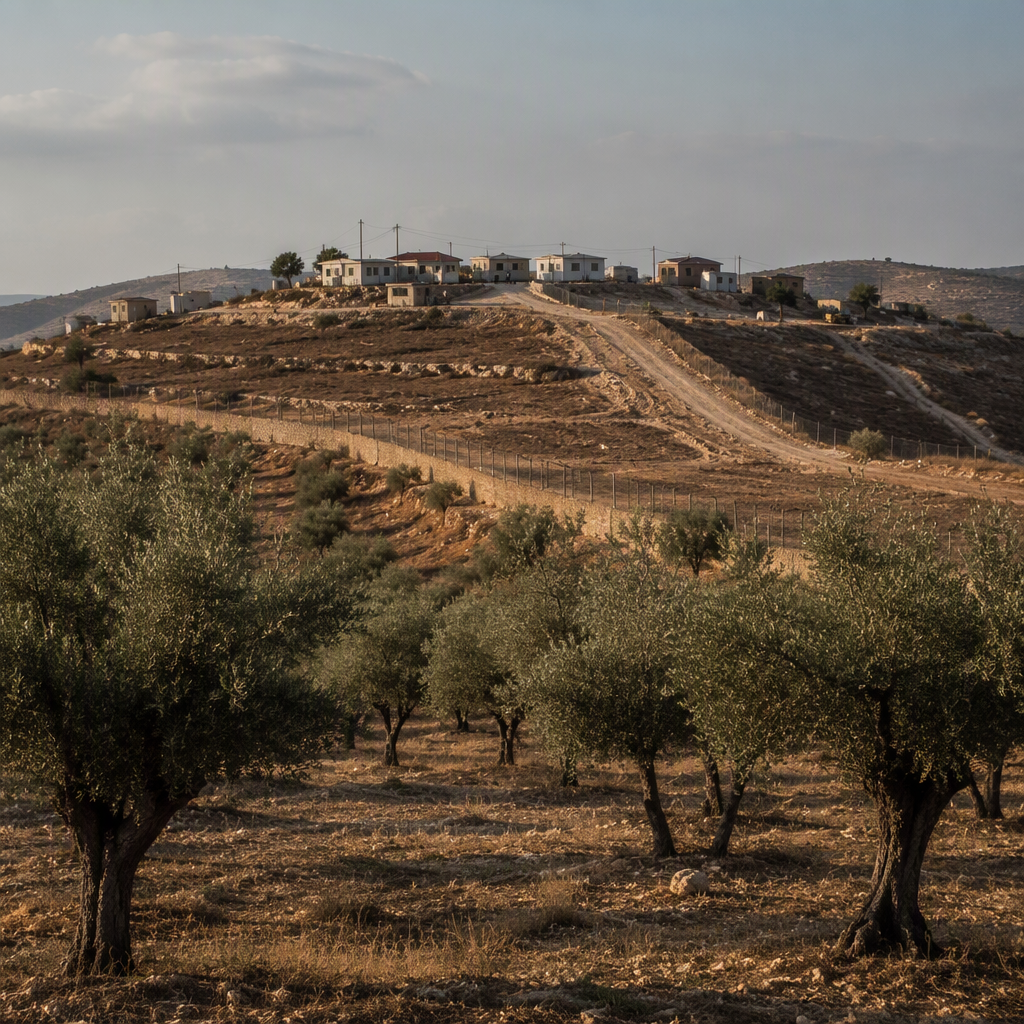
A single pastoral outpost—often consisting of merely a makeshift trailer, a small sheep corral, and a handful of young settlers—can effectively control thousands of dunams (hundreds of hectares) of surrounding territory. Israeli rights group Peace Now notes that grazing outposts are far more cost-effective for seizing large territories than conventional construction, as herds can graze across sweeping valleys while herders block Palestinian farmers from accessing their ancestral lands, water cisterns, and olive groves.
Over time, these informal outposts receive state-funded access roads, water infrastructure, electricity connections, and security coverage from the Israel Defense Forces (IDF), gradually solidifying their physical and legal presence.
Escalating Violence and Documented Tactics
International observers and local residents report that intimidation plays a pivotal role in pushing Palestinian communities off their lands. Reported incidents include physical assaults, the burning of homes and vehicles, destruction of olive trees, livestock theft, and targeted threats delivered directly to remote hamlets.
Communities in Area C—the 60 percent of the West Bank under full Israeli civil and military control according to the Oslo Accords—face the brunt of these pressures. Bedouin and herding villages such as Zanuta in the South Hebron Hills and Wadi al-Siq east of Ramallah have seen entire populations evacuate after facing repeated nighttime raids and verbal ultimatums from armed settlers.
While the Israeli military frequently states that it acts to protect all residents and maintain public order, human rights organizations argue that soldiers frequently stand by or intervene only when Palestinians attempt to resist or defend their properties.
The Shield of Impunity
A critical pillar sustaining Israeli settler land grabs is what legal watchdogs describe as an overwhelming lack of accountability. Israeli legal advocacy group Yesh Din has tracked criminal complaints filed by Palestinians regarding settler violence for nearly two decades.
Yesh Din’s long-term research reveals that more than 93 percent of all investigations into ideologically motivated crimes committed by Israelis against Palestinians in the West Bank are closed without an indictment. Indictments that are filed rarely lead to substantial prison terms. Conversely, Palestinians suspected of offenses in the West Bank are tried in Israeli military courts, where conviction rates exceed 95 percent.
This dual legal system creates an environment where radicalized settlers operate with minimal fear of domestic legal consequences, reinforcing the cycle of displacement.
Political Backing and Government Policy
The acceleration of outpost construction coincides with the rise of religious nationalist figures into senior cabinet positions within the Israeli government. Ministers who openly champion West Bank annexation now oversee civilian administration and planning bodies in the territory.
Under current policy directives, the government has retroactively legalized dozens of wildcat outposts, designated thousands of dunams as “state land,” and allocated millions of shekels toward settlement infrastructure. Israeli officials defend these actions, asserting Jewish historical and biblical ties to Judea and Samaria—the biblical terms for the West Bank—and stating that planning policies are enacted according to state legal procedures.
International Response and Sanctions
The scale of rural displacement has triggered unprecedented responses from Western allies. The United States, the European Union, the United Kingdom, Canada, and France have enacted targeted sanctions against individual extremist settlers, unauthorized outposts, and affiliated entities accused of undermining stability and peace in the West Bank.
While foreign diplomats describe the sanctions as a necessary measure against destabilizing actions, Israeli authorities have largely dismissed the foreign measures, framing them as unwarranted interference in domestic affairs.
What Happens Next
Legal challenges against outpost retroactivity continue to move through the Israeli Supreme Court, but field realities often outpace judicial proceedings. Without systemic enforcement reforms and decisive intervention by military authorities, rights groups warn that remaining pastoral communities across Area C remain at immediate risk of depopulation, further reducing the territorial viability of any future two-state solution.
Conclusion
The persistence of unauthorized outposts and physical pressure represents a systematic realignment of the West Bank landscape. As international concern grows, addressing Israeli settler land grabs will require more than symbolic sanctions; it demands structural accountability, the enforcement of the rule of law, and a decisive halt to rural displacement.