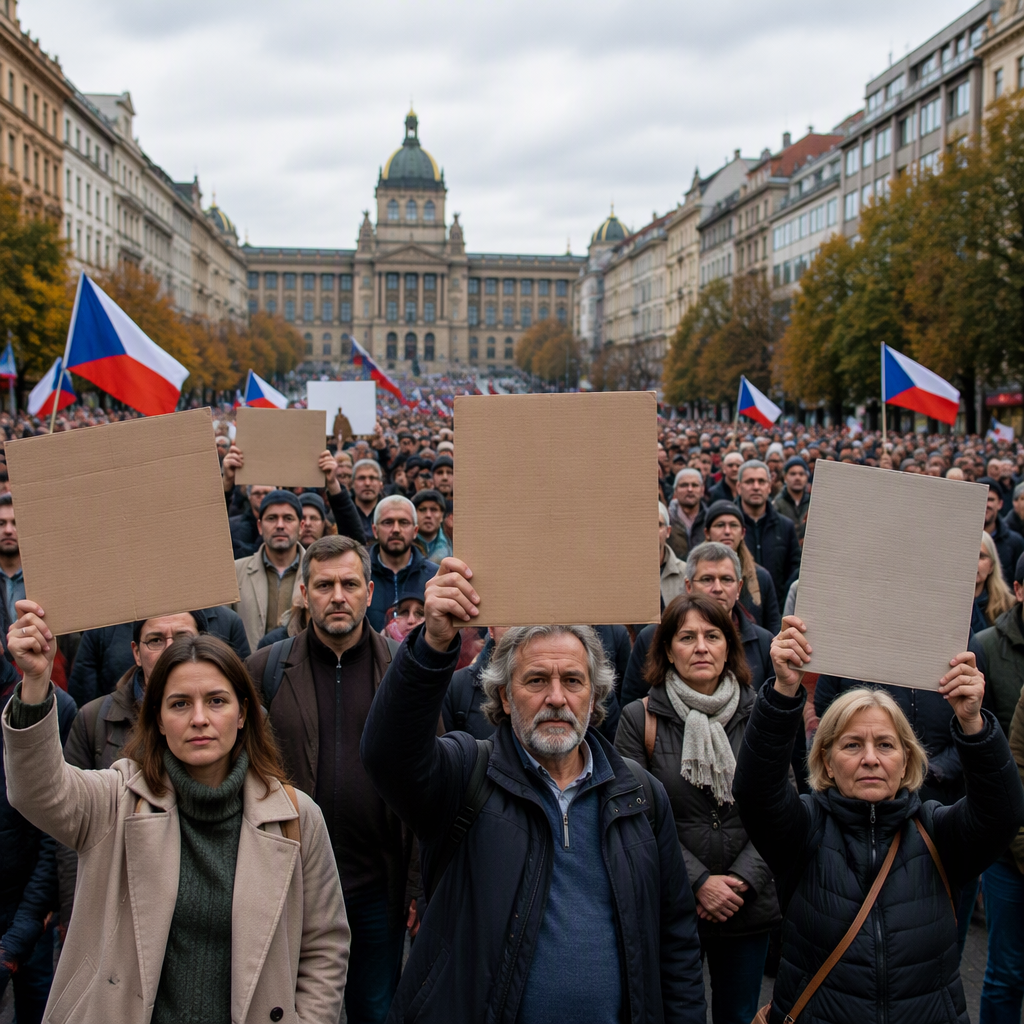

Thousands Protest in Prague Against Public Media Funding Reforms
Thousands of demonstrators gathered in the Czech capital of Prague on Thursday to oppose government-backed public media funding reforms. The protests drew a diverse crowd of citizens, trade unionists, and opposition political figures who argue that the proposed legislative changes impose an unfair financial burden on households and businesses while failing to guarantee institutional impartiality.
The demonstration, centered in Wenceslas Square, highlighted growing public dissatisfaction with planned increases to monthly television and radio licence fees. Protesters waved banners, chanted slogans demanding government accountability, and called for a withdrawal of the so-called “large media amendment.”
Also read: Thousands Demonstrate in Paris as Protests Spread Across Europe
Public Media Funding Reforms Spark Backlash
Under the proposed public media funding reforms, the monthly fee for Czech Television (Česká televize) is set to rise, alongside a smaller adjustment for Czech Radio (Český rozhlas). These broadcast fees have remained unchanged for nearly two decades, leading the coalition government led by Prime Minister Petr Fiala to argue that inflation has severely eroded the broadcasters’ purchasing power.
However, critics contend that raising compulsory payments during a period of sustained cost-of-living pressures is unacceptable. Protesters voiced frustration with escalating utility and living costs, arguing that public media should instead find internal efficiencies before demanding higher payments from the public.
“People are already dealing with high energy bills and grocery prices,” said one demonstrator addressing the crowd. “Mandating higher payments for state-mandated broadcasting at this time ignores the economic reality of ordinary citizens.”
Expansion of Licence Fees to Digital Devices
A central pillar of the reform that generated significant anger among protesters is the proposed expansion of the definition of a fee payer. Under the current legislation, only households owning a traditional television or radio receiver are legally obligated to pay the monthly fees.
The new framework extends this requirement to any device capable of receiving digital broadcast content, including smartphones, tablets, and internet-connected computers. Critics argue this measure effectively creates a general digital media tax, forcing individuals to pay regardless of whether they consume public broadcaster content.
Business associations have also voiced objections, noting that companies providing mobile phones or computers to employees could face increased operational costs under the expanded regulations.
Political Divisions and Industry Reaction
The Prague demonstration was supported by several opposition lawmakers who have consistently obstructed the bill during parliamentary debates. Opposition parties have labeled the reform regressive, arguing that alternative financing models, including direct state budget allocations or voluntary subscription frameworks, should be considered.
Conversely, supporters of the reform, including public broadcast executives and cultural figures, warn that failing to update funding mechanisms will jeopardize the quality and independence of public service journalism. Proponents maintain that relying directly on the state budget could leave public broadcasters vulnerable to political pressure from sitting governments, making autonomous licence fees the safest method to protect democratic accountability.
Czech Television and Czech Radio have maintained that without adjusted revenues, they will face significant programmatic cuts, including the reduction of regional reporting, cultural broadcasting, and original domestic production.
What Happens Next
Following the demonstration, the reform legislation faces ongoing scrutiny in the Czech Parliament. Opposition factions have vowed to utilize parliamentary procedures, including prolonged filibusters, to delay or amend the bill as it moves through subsequent readings.
The government coalition retains a majority in the Chamber of Deputies and intends to push the measure forward ahead of the upcoming legislative cycle. As debate continues, the controversy over public media funding reforms highlights the delicate balance between securing independent journalism and managing public financial burdens.
1 Comment
Comments are closed.