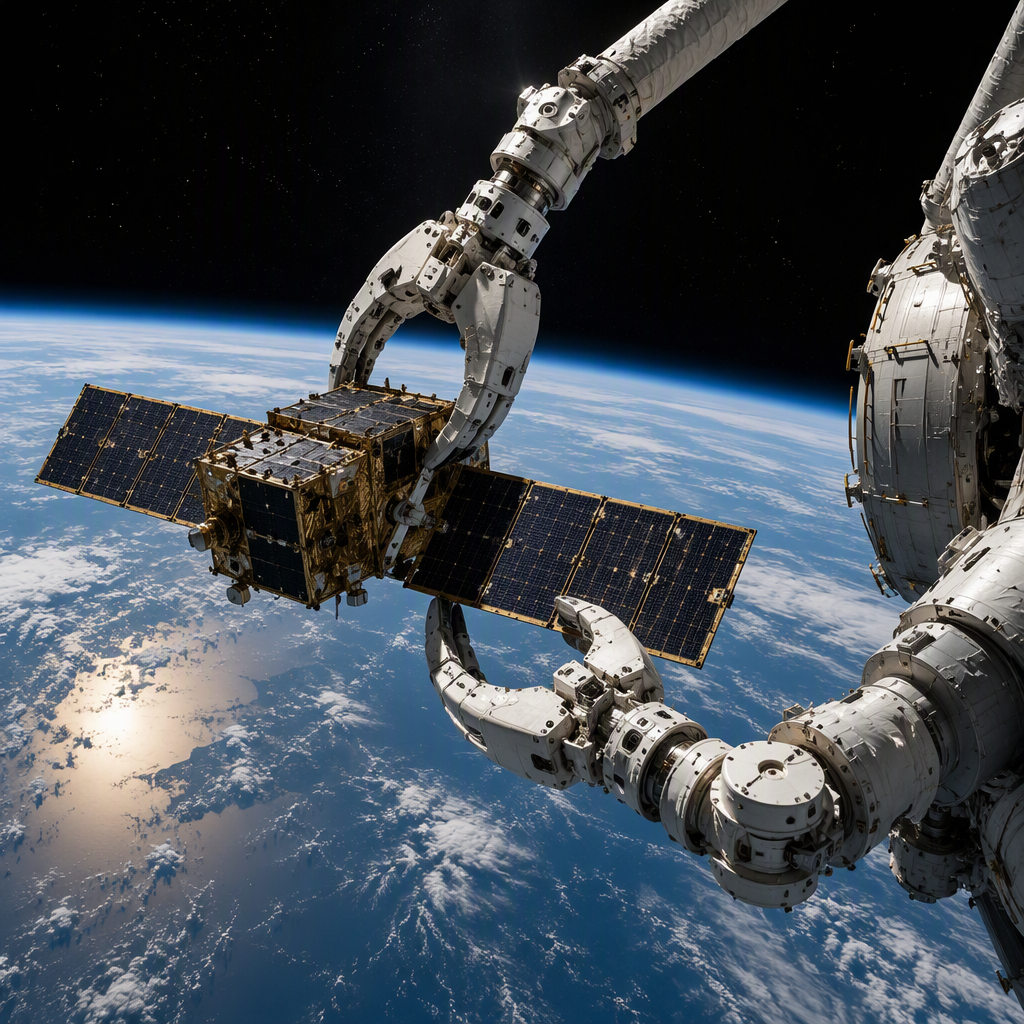

Giant Robotic Claws Set to Grab Dead Satellites in Space
In a groundbreaking push to clean up Earth’s increasingly crowded orbital highways, aerospace engineers are preparing to deploy giant robotic claws to grab dead satellites in space. As decades of space exploration leave thousands of defunct spacecraft and spent rocket stages hurtling around the planet, active debris removal missions are shifting from theoretical concepts into active engineering reality.
Low Earth orbit (LEO) has transformed into a bustling hub for commercial mega-constellations, telecommunications networks, and scientific observation platforms. However, defunct satellites pose a persistent collision hazard that threatens operational missions, human spaceflight, and the long-term sustainability of the space economy.
Also read: How U.S. Adversaries Are Preparing to Take War into Outer Space
The Growing Threat of Orbital Space Debris
Earth’s orbit currently holds tens of thousands of trackable debris fragments, alongside millions of micro-particles traveling at hypervelocity speeds exceeding 17,500 miles per hour. Even a speck of paint moving at orbital velocity can crack a spacecraft window, while a collision with a multi-ton derelict satellite could trigger a destructive chain reaction known as the Kessler syndrome.
Because dead satellites cannot maneuver to avoid potential impacts, international space agencies have emphasized the urgent need for active remediation. Rather than waiting decades for derelicts to naturally decay into Earth’s atmosphere, engineers must physically capture and remove high-risk objects from orbit.
How Engineers Will Grab Dead Satellites in Space
To safely secure tumbling, non-cooperative derelicts, specialized cleanup spacecraft rely on advanced robotic manipulation. Unlike cooperative docking—where a functioning satellite aligns itself with a visiting craft—dead satellites tumble uncontrollably and lack standard docking interfaces.
The robotic claw architecture solves this dilemma by using four mechanical arms equipped with multi-jointed linkages and tactile sensors. A dedicated “chaser” spacecraft uses onboard lidar, optical cameras, and artificial intelligence algorithms to match the spin rate and trajectory of the target object. Once synchronized, the robotic claw gently closes around the satellite, securing it in a firm mechanical grasp without generating additional fragmentation.
After locking onto the target, the chaser uses its onboard thrusters to execute a controlled deorbit burn. This maneuver lowers the craft’s orbital perigee, steering both the cleanup vehicle and the defunct satellite toward a safe, fiery reentry over unpopulated stretches of the South Pacific Ocean.
Pioneering Missions and ClearSpace-1
Leading the operational deployment of this capture technology is ClearSpace-1, a flagship mission commissioned by the European Space Agency (ESA) and developed by Swiss startup ClearSpace. The mission serves as a critical proof-of-concept for commercial active debris removal.
Engineers initially selected a conical payload adapter left behind by a Vega rocket launch as the primary capture target. ClearSpace engineers have systematically refined the claw’s actuation mechanisms and guidance systems to ensure the vehicle can capture uneven, reflective, and thermally stressed surfaces in the harsh environment of space.
While robotic claws offer a versatile mechanical capture method, other international teams are testing complementary technologies, such as magnetic docking plates, harpoons, and deployable capture nets. However, robotic arms and articulated claws remain the preferred choice for handling irregular, unstandardized debris.
What Happens Next in Orbital Remediation
As flight demonstrations progress toward launch, orbital cleanup missions face technical, regulatory, and financial hurdles. Space salvage operations require precise legal coordination, as international space treaties dictate that space objects remain the sovereign property of the launching state indefinitely.
Space agencies and private operators are working together to develop standardized docking fixtures for future satellites, making future servicing missions less complex. Simultaneously, space insurers and regulatory bodies are considering stricter end-of-life disposal rules, requiring operators to carry certified deorbiting capabilities before receiving orbital launch licenses.
Conclusion
The introduction of claw-equipped capture spacecraft marks a transformative milestone in orbital stewardship. As space traffic grows at an exponential rate, proven systems that can reliably grab dead satellites in space will be vital to keeping Earth’s orbital environment safe, accessible, and sustainable for generations to come.